


Key Takeaways
-
Hyperbaric oxygen therapy (HBOT) saturates tissues with pressurized oxygen; red light therapy (RLT) uses specific wavelengths of light to stimulate cellular energy production. They work through completely different mechanisms.
-
HBOT has the stronger clinical evidence base, with FDA-cleared indications for 14+ conditions, including wound healing, radiation injuries, and gas gangrene.
-
Red light therapy shows genuine promise for inflammation, skin rejuvenation, and joint pain, but clinical evidence is still maturing for most applications.
-
The two therapies are not competitors; they can be layered strategically, with most practitioners recommending RLT before HBOT sessions.
-
Cost, access, and the condition you're targeting should drive your decision, not marketing hype.
What Is Hyperbaric Chamber vs Red Light Therapy?
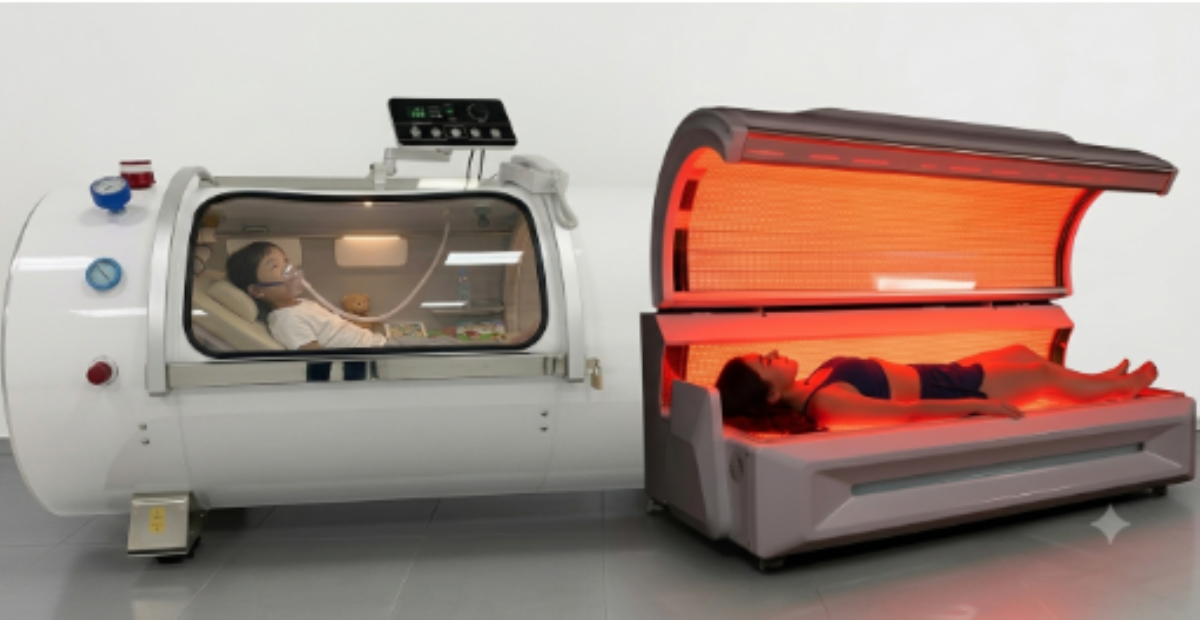
Hyperbaric oxygen therapy (HBOT) places you inside a pressurized chamber, either a hard-shell medical unit or a soft portable chamber, and floods your body with pure or high-concentration oxygen at pressures above sea level. That pressure forces dissolved oxygen deep into plasma, tissues, and fluids that red blood cells never reach under normal conditions. The result is a systemic, whole-body oxygen surge that accelerates healing at the cellular level.
Red light therapy (RLT), also called photobiomodulation (PBM), uses LED panels or laser devices emitting wavelengths typically between 630 and 850 nanometers. Those wavelengths penetrate skin and underlying tissue, where mitochondria absorb the photons and convert them into ATP, the cellular fuel that drives repair, reduces inflammation, and signals collagen production.
The simplest way to frame the difference: HBOT delivers a resource (oxygen under pressure). RLT delivers a signal (light energy that triggers biological cascades). One floods your cells with raw material; the other tells your cells to work harder with what they already have.
Why This Comparison Matters Right Now
Both therapies have exploded in popularity over the last five years, moving from clinical settings into wellness centers, sports recovery facilities, and home setups. That growth has generated real confusion and some genuinely bad advice about which therapy fits which condition, and whether combining them is safe.
Athletes, chronic illness patients, and biohackers are all asking the same questions. Clinics are offering both under one roof. And the price gap between a 90-minute HBOT session ($150–$400) versus a home red light panel ($200–$3,000 one-time) is driving people toward decisions based on budget rather than biology.
Getting this right matters. HBOT is not a casual wellness purchase; it carries real physiological effects, pressure contraindications, and session protocols that need to match your health status. RLT is lower-risk but also lower-powered for serious conditions. Conflating the two leads to undertreatment, wasted spending, or, in rare cases, safety issues.
Hyperbaric Chambers and Red Light Therapy Collections You May Want to Explore


How Each Therapy Works Inside Your Body
Hyperbaric Oxygen Therapy: The Pressure Advantage
Under normal atmospheric pressure, oxygen binds almost exclusively to hemoglobin. HBOT changes that equation. At 1.5–3.0 atmospheres absolute (ATA), oxygen dissolves directly into plasma, cerebrospinal fluid, and lymph, reaching ischemic (oxygen-starved) tissue that compromised circulation can't serve.
That oxygen-rich environment produces several downstream effects:
-
Angiogenesis: the formation of new blood vessels in damaged tissue
-
Neurogenesis stimulation of new neural pathway development
-
Antimicrobial action oxygen-toxic kill of anaerobic bacteria (critical for infections like gas gangrene, where HBOT for gas gangrene is a life-saving protocol)
-
Reduced inflammation suppression of inflammatory cytokine cascades
-
Enhanced stem cell mobilization studies show up to 800% increase in circulating stem cells after 20 sessions
The FDA has cleared HBOT for 14 conditions, including decompression sickness, diabetic foot ulcers, radiation tissue damage, and carbon monoxide poisoning. Many clinics also offer it for off-label applications, including traumatic brain injury, long COVID, and athletic recovery areas where evidence is strong but regulatory approval lags.
Red Light Therapy: The Mitochondrial Signal
RLT operates through a process called photobiomodulation. Cytochrome c oxidase, an enzyme in the mitochondrial respiratory chain, has a high absorption affinity for red and near-infrared wavelengths. When photons hit that enzyme, it accelerates electron transport, producing more ATP, more repair signaling, and less oxidative stress.
Clinical effects documented in peer-reviewed literature include:
-
Reduced joint inflammation in arthritis and connective tissue disorders
-
Accelerated skin wound closure and collagen synthesis
-
Improved muscle recovery markers post-exercise
-
Modest improvements in cognitive function in early studies
-
Pain reduction in conditions including neuropathy and tendinopathy
The key limitation is penetration depth. Red light (630–700nm) reaches roughly 1–2 centimeters. Near-infrared (700–1,100nm) penetrates 3–5 centimeters. Neither reaches deep organs, bone marrow, or the bloodstream the way pressurized oxygen does.
Conditions: Where Each Therapy Has the Edge

This is where the comparison gets practical. Not every condition benefits equally from both.
Where HBOT Clearly Leads
|
Condition |
HBOT Evidence Level |
RLT Evidence Level |
|
Diabetic foot ulcers |
Strong (FDA-cleared) |
Limited |
|
Radiation tissue damage |
Strong (FDA-cleared) |
Minimal |
|
Gas gangrene / necrotizing infections |
Strong (FDA-cleared) |
Contraindicated |
|
Carbon monoxide poisoning |
Strong (FDA-cleared) |
None |
|
Traumatic brain injury |
Moderate–Strong |
Early/Emerging |
|
Neurological conditions |
Moderate (see HBOT for nervous system) |
Limited |
|
Peripheral artery disease |
Moderate |
Minimal |
HBOT's systemic oxygen delivery makes it the clear choice for conditions involving compromised circulation, serious infection, or deep tissue oxygen deficits.
Where RLT Holds Its Own or Leads
|
Condition |
RLT Evidence Level |
HBOT Evidence Level |
|
Superficial skin rejuvenation |
Strong |
Moderate |
|
Acne / rosacea |
Moderate |
Limited |
|
Joint pain/arthritis (surface joints) |
Moderate |
Moderate |
|
Post-exercise muscle recovery |
Moderate |
Moderate |
|
Hair growth stimulation |
Moderate |
Minimal |
|
EDS (Ehlers-Danlos Syndrome) |
Emerging |
Limited |
For surface-level tissue targets, such as skin, superficial joints, and hair follicles, RLT's penetration is sufficient, and its lower cost and zero-pressure profile make it attractive.
Where Combining Both Makes Sense
Athletic recovery is the clearest case. RLT pre-session reduces baseline inflammation and primes mitochondrial activity. HBOT post-workout floods recovering muscle with oxygen at a level no supplement or sauna can match. For comparison on HBOT versus other recovery modalities, the breakdown of HBOT vs sauna is worth reviewing, as the mechanisms and use cases are more distinct than most people assume.
Chronic wound care, post-surgical recovery, and neuroinflammation cases are also increasingly seeing combined protocols in integrative medicine settings.
Cost, Access, and Practical Considerations

Hyperbaric Chamber
-
Clinical session cost: $150–$400 per session; most protocols require 20–40 sessions
-
Home soft chamber purchase: $3,000–$10,000 (operates at lower pressures, 1.3–1.5 ATA)
-
Hard-shell home units: $15,000–$80,000+
-
Insurance: Covered for FDA-cleared indications; off-label use is typically out-of-pocket
-
Session length: 60–120 minutes
-
Availability: Growing rapidly, hyperbaric oxygen therapy in Tacoma and hyperbaric chambers in Sioux Falls are examples of how clinic access has expanded into mid-size markets
If you're exploring whether to purchase a unit for home use, soft hyperbaric chambers offer a lower-cost entry point, while hard-shell hyperbaric chambers deliver clinical-grade pressure for serious protocols.
Red Light Therapy
-
Clinical session cost: $30–$100 per session
-
Home panel purchase: $200–$3,000 (wide quality range, wavelength accuracy matters enormously)
-
Insurance: Not typically covered
-
Session length: 10–20 minutes
-
Availability: Extremely broad home panels, tanning salons, wellness studios, and med spas
RLT's access and cost advantage is real. For maintenance-level use and surface conditions, a quality home panel pays for itself within months versus ongoing clinic visits.
Common Mistakes and Misconceptions
Mistake 1: Assuming red light therapy is a gentler HBOT.
They don't share a mechanism. Calling RLT a "mild alternative" to HBOT is like calling a massage a mild alternative to surgery. They do different things.
Mistake 2: Thinking HBOT is only for divers or hospitals.
Decompression sickness was HBOT's origin story, but the therapy now has documented applications across neurology, oncology support, sports medicine, and metabolic health. Most people receiving HBOT today have never been near a scuba tank.
Mistake 3: Buying cheap red light panels without checking wavelengths.
Consumer panels vary wildly in actual output. A panel that emits mostly outside the 630–850nm therapeutic window delivers decorative, not therapeutic, light. Always verify spectral output data before purchasing.
Mistake 4: Skipping contraindication screening for HBOT.
Untreated pneumothorax, certain chemotherapy agents, and severe claustrophobia are real contraindications. HBOT is safe for the vast majority of people, but a health history review matters especially for home use.
Mistake 5: Expecting either therapy to replace medical treatment.
Both therapies are adjunctive. They support and accelerate the body's healing processes. Neither replaces antibiotics for active infection, surgery for structural damage, or pharmacological management of chronic disease.
How to Decide: A Simple Framework

Use this decision framework before booking or buying:
-
Identify your primary goal. Deep tissue healing, systemic oxygenation, or nerve/organ recovery → HBOT. Surface skin, superficial joint, or mitochondrial stimulation → RLT. Both goals → consider stacking.
-
Assess your baseline health. Anyone with respiratory issues, ear conditions, or taking certain medications should consult a physician before HBOT. RLT has a very low contraindication profile.
-
Set a realistic protocol. HBOT benefits accumulate over 20–40 sessions. RLT works best with consistent use, 3–5 times per week. One-off sessions rarely produce lasting results.
-
Match your budget to commitment. A 40-session HBOT protocol at $200/session is an $8,000 investment. That budget may justify purchasing a soft chamber for home use if long-term treatment is the plan.
-
Find qualified providers. For HBOT, look for clinics staffed by trained hyperbaric technicians or physicians. For RLT, verify the panel's wavelength specs and irradiance data before committing.
FAQ
Should you do red light before or after the hyperbaric chamber?
Do red light therapy before your hyperbaric session, not after. RLT pre-HBOT primes mitochondrial activity by boosting cytochrome c oxidase function, which means your cells are already in an upregulated repair state when the oxygen surge from HBOT arrives. Post-HBOT, your tissues are already flooded with oxygen and in active recovery mode, adding RLT at that point produces diminishing returns and may overstimulate tissue that needs rest. Most integrative protocols that stack both therapies use a 10–20 minute RLT session 30–60 minutes before entering the chamber.
Why don't doctors recommend red light therapy?
Most conventional physicians don't recommend RLT because it falls outside standard medical training curricula, not because the evidence is absent. Medical school and residency programs rarely cover photobiomodulation, so most physicians simply haven't engaged with the research. That said, evidence quality is genuinely uneven; some RLT applications (wound healing, musculoskeletal pain, skin conditions) have solid peer-reviewed support, while others are extrapolated from small or industry-funded studies. Physicians also face liability pressure around recommending therapies outside established guidelines. The honest picture: RLT is neither the miracle cure wellness marketers claim, nor the pseudoscience skeptics dismiss it as. It works for specific applications within its physical limitations.
Can red light therapy cure basal cell carcinoma?
Red light therapy does not cure basal cell carcinoma and should not be used as a replacement for medical treatment. There is a related but distinct treatment called photodynamic therapy (PDT), a clinical procedure where a photosensitizing agent is applied to the lesion and then activated by specific light wavelengths. PDT has FDA approval for certain superficial basal cell carcinomas and actinic keratoses. This is completely different from consumer red light panels or wellness RLT sessions. Using an over-the-counter RLT device on a suspected or confirmed skin cancer is dangerous and may allow the malignancy to progress while creating false reassurance. If you have or suspect basal cell carcinoma, see a dermatologist.
Can red light help with EDS?
Early evidence suggests red light therapy may provide symptomatic relief for some Ehlers-Danlos Syndrome (EDS) patients, particularly around joint pain, inflammation, and wound healing impairment, but no clinical trials have been conducted specifically in EDS populations. The theoretical basis is sound: EDS involves defective collagen structure and chronic tissue inflammation, and RLT has documented effects on both collagen synthesis and inflammatory cytokine reduction. Anecdotal reports from EDS communities describe meaningful pain relief and improved skin healing with consistent use. HBOT has also been explored in connective tissue conditions, given its anti-inflammatory and tissue-oxygenation mechanisms. If you have EDS and are considering either therapy, work with a clinician familiar with your subtype and current symptom picture, since hypermobility-related instability requires thoughtful positioning during any therapy session.
Conclusion
Hyperbaric chamber vs red light therapy isn't really a competition; it's a question of mechanism match. HBOT delivers pressurized oxygen systemically, producing documented results for deep tissue injuries, vascular insufficiency, serious infections, and neurological repair. Red light therapy delivers a photonic signal to mitochondria, producing documented results for surface tissue, skin health, joint inflammation, and recovery support.
For serious conditions with clinical urgency, HBOT is the stronger tool. For maintenance, performance optimization, and surface-level healing, RLT holds its own at a fraction of the cost and commitment. For people with the resources and the right clinical picture, stacking both RLT before HBOT may amplify outcomes beyond either alone.
The worst decision is choosing based on hype rather than mechanism. Know what you're treating, understand the depth that needs to be reached, and match the therapy to the biology.
Ready to explore hyperbaric oxygen therapy? Airvida Chambers operates clinics and supplies chambers for home use across the country. Whether you're looking for HBOT in Tacoma, hyperbaric therapy in Sioux Falls, or a soft chamber for home protocols, the team can match you to the right setup for your health goals. Book a consultation and start with a protocol built around your actual needs, not a trend.