


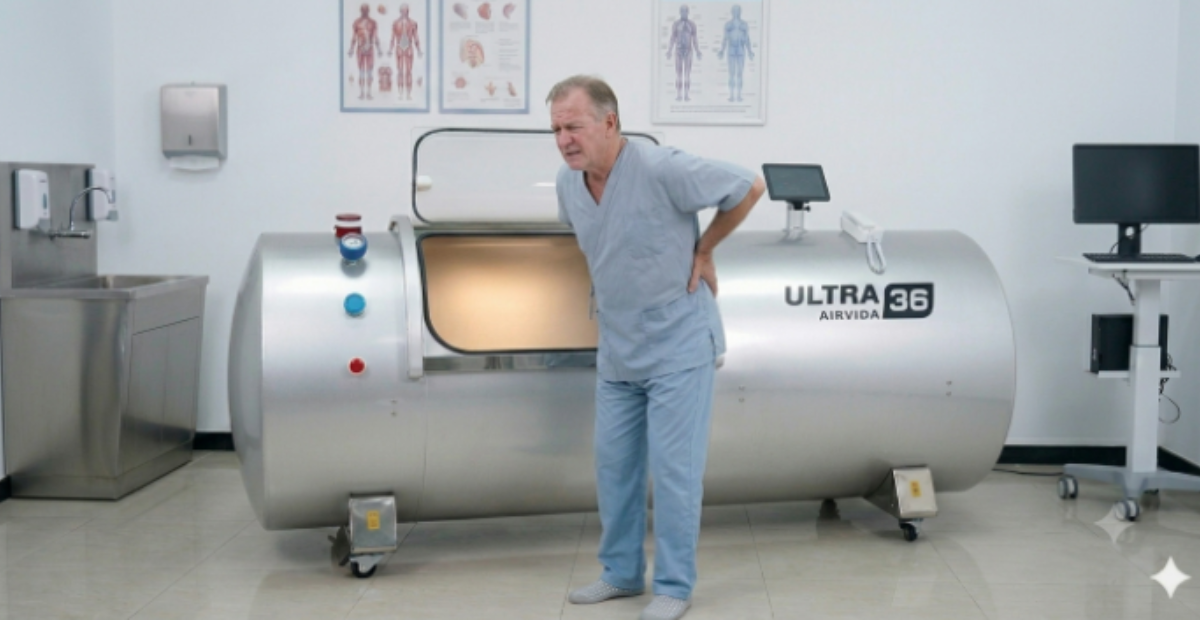
Hyperbaric oxygen therapy (HBOT) delivers 100% oxygen inside a pressurized chamber, raising blood oxygen levels well above what normal breathing achieves. Research on HBOT for back pain is still in early stages, but published systematic reviews show consistent reductions in pain and modest functional improvements across musculoskeletal pain conditions. Evidence specific to chronic back pain remains limited, and high-quality, controlled trials targeting the spine are still needed before HBOT can be considered a standard treatment.
Key Takeaways
-
HBOT delivers pressurized, high-concentration oxygen that raises tissue oxygen levels and may reduce inflammation involved in spinal and musculoskeletal pain.
-
A 2025 systematic review of 18 studies found consistent pain reductions in musculoskeletal conditions including fibromyalgia and postoperative pain, though evidence for back pain specifically remains limited.
-
Spinal cord injury research shows HBOT may support neurological recovery, particularly for incomplete injuries treated early, but standardized protocols are still lacking.
-
HBOT is not a standalone cure for back pain. It is best understood as a potential adjunctive therapy used alongside other treatments.
-
Certain individuals should not use HBOT, including people with untreated pneumothorax, specific lung conditions, or certain medication histories.
-
Session duration typically ranges from 60 to 90 minutes, and full treatment courses can span anywhere from 3 to 60 sessions depending on the condition and protocol.
What Is Hyperbaric Oxygen Therapy and How Does It Work for Back Pain?
Hyperbaric oxygen therapy is a medical treatment in which you breathe 100% oxygen inside a pressurized chamber at levels above normal atmospheric pressure, typically between 1.3 and 2.5 atmospheres absolute (ATA). At this elevated pressure, oxygen dissolves into your blood plasma at much higher concentrations than it would under normal conditions. This super-saturation of oxygen is believed to support tissue repair, reduce inflammation, and promote new blood vessel growth in areas with restricted circulation.
When applied to back pain, the proposed mechanism centers on oxygen's role in healing damaged discs, compressed nerves, and inflamed spinal tissue. Many forms of back pain involve localized hypoxia, a state where tissue oxygen supply is inadequate. By flooding these tissues with oxygen, HBOT may accelerate cellular repair and dampen the inflammatory signals that sustain chronic pain.
It is important to understand that HBOT operates on biological principles that apply broadly across tissues, not just the spine. Research on related conditions like fibromyalgia and complex regional pain syndrome (CRPS) suggests that pain modulation through oxygenation is biologically plausible. The key point is that while the mechanism is scientifically grounded, its direct application to back pain requires more rigorous, condition-specific clinical evidence.
What Does the Research Say About HBOT and Back Pain?

Research on HBOT for back pain is promising but incomplete, with most evidence coming from studies on broader musculoskeletal pain categories rather than isolated spinal conditions. A December 2025 systematic review published in a peer-reviewed journal and indexed in PMC analyzed 18 studies, including 17 randomized controlled trials and 1 case series, involving 671 participants. The review found consistent reductions in pain and modest functional improvements, particularly for fibromyalgia and postoperative conditions such as knee arthroplasty and peripheral nerve repair. HBOT protocols across these studies ranged from 3 to 60 sessions, lasting 60 to 90 minutes, at approximately 1.3 to 2.5 ATA.
A PRISMA-guided systematic review published in August 2025 and available through PMC covered studies from January 2000 through August 2025 and reached a similar conclusion: HBOT may provide adjunctive benefits in musculoskeletal pain syndromes, yet the current evidence remains limited. Standardized treatment protocols and high-quality trials are still needed to better define its clinical applicability. For spinal cord injury specifically, a 2026 review of 50 studies involving 1,102 patients found that neurological improvement was more frequently observed in incomplete injuries and when HBOT was initiated early.
A separate Cochrane systematic review on bone fracture healing found no evidence from randomized trials supporting the use of HBOT for poorly healing broken bones. Another Cochrane review covering soft tissue injuries found that nine small trials involving 219 participants did not provide sufficient evidence to conclude HBOT helps with sprains or closed soft tissue injuries. The bottom line is that the published research justifies continued investigation but does not yet establish HBOT as a proven, first-line treatment for back pain.
Can HBOT Help With Spinal Conditions Specifically?
Spinal applications of HBOT represent one of the most actively studied areas within the broader field of hyperbaric medicine, particularly for spinal cord injury (SCI). A 2026 ScienceDirect review examined the mechanisms and research outcomes of HBOT for spinal cord injury and found that HBOT may serve as a useful adjunct in selected patients. The authors noted that secondary injury processes, including inflammation, oxidative stress, and impaired blood flow, are the primary targets of HBOT in this context.
For conditions like spondylodiscitis, a spinal infection involving the vertebrae and intervertebral discs, a study published in PMC found that HBOT can play a supportive role in managing infection-related spinal damage. HBOT's antimicrobial and tissue-repair properties may help control bacterial growth and promote healing in oxygen-deprived spinal tissue. However, these applications are condition-specific and are not generalizable to all back pain presentations.
Degenerative disc disease, herniated discs, and musculoligamentous back pain are far more common than SCI or spondylodiscitis, yet they have received comparatively little direct study in the context of HBOT. The research that does exist for musculoskeletal pain broadly, including the 2025 systematic review cited above, provides indirect support for exploring HBOT in these conditions. The key point is that HBOT's spinal applications are real but narrow, and most of the direct evidence applies to acute or traumatic injuries rather than chronic degenerative back pain.
Hyperbaric Collections You May Want to Shop

How Does HBOT Compare to Other Back Pain Treatments?
HBOT for back pain is best understood as a potential adjunctive therapy rather than a replacement for established treatments. The table below summarizes how HBOT compares to other commonly used back pain interventions across key dimensions.
|
Treatment |
Primary Mechanism |
Evidence Level for Back Pain |
Typical Duration |
|
Physical therapy |
Strengthening, mobility |
Strong |
Ongoing, weeks to months |
|
NSAIDs / analgesics |
Anti-inflammatory, pain blocking |
Strong |
Short-term use |
|
Epidural steroid injections |
Localized anti-inflammatory |
Moderate to strong |
Single to repeated sessions |
|
Spinal surgery |
Structural correction |
Moderate (condition-specific) |
One-time procedure |
|
HBOT |
Tissue oxygenation, inflammation reduction |
Limited, emerging |
3 to 60 sessions (60-90 min each) |
|
Acupuncture |
Neuromodulation |
Limited to moderate |
Ongoing sessions |
HBOT does not replace any of these options. Instead, it is most likely to be useful when layered onto an existing treatment plan, particularly in cases where inflammation and poor tissue oxygenation are driving the pain. People exploring HBOT alongside post-surgical recovery, for example, may find value in learning about hyperbaric benefits after plastic surgery, as the tissue-repair principles are similar.
The bottom line is that HBOT occupies an exploratory position in back pain management, with a mechanism that is scientifically plausible but clinical evidence that has not yet reached the strength of established first-line treatments.
What Back Pain Conditions Might Respond to HBOT?
Several back-adjacent and musculoskeletal pain conditions have shown some positive response to HBOT in peer-reviewed research, suggesting a subset of back pain patients may benefit more than others.
Conditions with the strongest indirect evidence include:
-
Fibromyalgia: Multiple studies within the 2025 systematic review reported pain reduction and improved function with HBOT.
-
Complex Regional Pain Syndrome (CRPS): A 2025 study published in Clinical Journal of Pain explored HBOT for CRPS management, a condition involving severe, chronic pain that can affect the spine and extremities.
-
Spinal cord injury: Incomplete SCI treated early with HBOT showed more frequent neurological improvement across 50 reviewed studies.
-
Spondylodiscitis: HBOT has been studied as an adjunct in managing this spinal infection condition.
-
Postoperative spinal recovery: Tissue repair mechanisms suggest a potential role for HBOT following spinal surgery, though direct evidence is limited.
Patients managing systemic conditions alongside back pain may also find relevant context in related HBOT applications. For instance, people exploring HBOT for chronic Lyme often report musculoskeletal pain as a primary symptom, and inflammation reduction is a shared treatment goal. Similarly, patients with autoimmune-related pain may be interested in research on HBOT for Hashimoto's.
The key point is that your specific back pain diagnosis matters greatly when evaluating HBOT's potential benefit. Inflammatory, infectious, and post-traumatic causes may respond better than purely mechanical or degenerative sources.
Who Should Not Use a Hyperbaric Chamber?
Contraindications to HBOT are specific medical conditions or situations that make the therapy unsafe, and you should review these carefully with a qualified physician before beginning any treatment course.
Absolute and relative contraindications include:
-
Untreated pneumothorax: This is the only widely accepted absolute contraindication. A collapsed lung can expand dangerously under pressure changes.
-
Certain pulmonary conditions: Severe emphysema, bullous lung disease, or other conditions that trap air in the lungs increase risk.
-
Active ear or sinus infections: Pressure equalization becomes difficult and painful when these passages are blocked.
-
Certain medications: Doxorubicin (an oncology drug), disulfiram, and cis-platinum may interact adversely with high-pressure oxygen. Always provide your full medication list to the treating physician.
-
Pregnancy: HBOT during pregnancy remains an area of ongoing investigation. It is generally reserved for life-threatening maternal conditions until more safety data are available.
-
Uncontrolled high fever: Elevated body temperature increases seizure risk, which HBOT may further elevate at high pressures.
-
Claustrophobia: Patients with severe claustrophobia may be unable to tolerate the enclosed environment of a monoplace chamber.
Beyond contraindications, certain populations may need modified protocols. Patients with a history of cardiac conditions, active seizure disorders, or recent ear surgery should receive individualized assessment. The bottom line is that HBOT is not universally safe for everyone, and medical clearance from a qualified practitioner is essential before starting therapy.
What Are the Risks and Side Effects of Hyperbaric Therapy?

The risks of HBOT are real but generally manageable when the therapy is administered correctly under appropriate supervision. Understanding them helps you make an informed decision.
Common side effects include:
-
Middle ear barotrauma: The most frequently reported side effect. Pressure changes can cause ear pain or temporary hearing changes if the Eustachian tube does not equalize properly.
-
Sinus pressure and discomfort: Similar to ear barotrauma, sinus congestion can make pressure changes painful.
-
Temporary vision changes: Some patients notice temporary nearsightedness after extended HBOT courses, which typically resolves after treatment ends.
-
Oxygen toxicity: At high pressures and extended durations, excess oxygen can trigger central nervous system effects including seizures. This risk is rare under properly supervised protocols.
-
Fatigue: Many patients report feeling tired after sessions, particularly in the early stages of a treatment course.
Serious adverse events are uncommon when HBOT is delivered within appropriate pressure parameters and session durations. The Undersea and Hyperbaric Medical Society (UHMS) has identified protocols and conditions where HBOT carries an acceptable risk-benefit profile. People exploring HBOT for complex systemic conditions, such as those researching HBOT for stem cell therapy or HBOT for dental implants, should apply the same rigorous safety evaluation. The key point is that HBOT carries a favorable safety profile in appropriate candidates, but it is not risk-free, and unsupervised use significantly increases those risks.
Hyperbaric Chambers You May Want to Shop
Explore More


How Long Does a Hyperbaric Session Last and How Many Do You Need?
HBOT session duration typically ranges from 60 to 90 minutes per session, based on protocols reported across peer-reviewed studies on musculoskeletal and pain conditions. The number of sessions needed varies considerably depending on the condition being treated, the pressure used, and the clinical response. Published research on musculoskeletal pain syndromes used treatment courses ranging from as few as 3 sessions to as many as 60 sessions.
For back-adjacent conditions specifically, no single universally accepted protocol exists. Spinal cord injury research has generally used earlier and more intensive protocols, while fibromyalgia studies have used moderate session counts over several weeks. Your treating physician should guide session number, pressure settings, and session length based on your specific diagnosis and response to treatment.
Practical session considerations include:
-
Arrive without petroleum-based products on your skin or hair, as these are flammable in an oxygen-enriched environment.
-
Dress in provided cotton clothing. Many facilities require this to reduce static electricity risk.
-
Plan to equalize ear pressure during descent by swallowing, yawning, or using the Valsalva maneuver.
-
Expect a rest period after the session, as fatigue is common, especially early in a treatment course.
-
Attend all scheduled sessions. Skipping sessions may reduce cumulative therapeutic benefit, though this has not been definitively studied for back pain.
The bottom line is that a typical HBOT course for musculoskeletal pain involves 60-to-90-minute sessions conducted over weeks, and the optimal number of sessions for back pain specifically remains an area of ongoing investigation.
Is a Hyperbaric Chamber Right for Your Back Pain?

HBOT is a biologically plausible adjunctive therapy for certain types of back pain, particularly those driven by inflammation, poor tissue oxygenation, or secondary injury to spinal structures. The current peer-reviewed evidence supports cautious optimism: systematic reviews from 2025 and 2026 consistently show pain reductions and functional improvements in musculoskeletal pain conditions, while also calling for higher-quality, condition-specific trials before HBOT can be positioned as a standard back pain treatment.
If you are managing chronic back pain and considering HBOT, the most productive step is a thorough consultation with a physician familiar with hyperbaric medicine. Bring your full diagnosis, medication list, imaging records, and history of prior treatments to that conversation. HBOT works best as part of a comprehensive pain management plan, not as a replacement for physical therapy, appropriate medications, or indicated procedures.
The bottom line: HBOT shows measurable promise for musculoskeletal pain conditions related to back pain, but evidence specific to chronic spinal pain remains limited, and individualized medical guidance is essential before starting therapy.
Frequently Asked Questions
Will a hyperbaric chamber help with back pain?
A hyperbaric chamber may help with back pain for some individuals, particularly those whose pain involves inflammation, poor tissue oxygenation, or spinal injury. Systematic reviews from 2025 show consistent pain reductions in musculoskeletal conditions, but evidence specific to isolated back pain is still limited. A physician consultation is essential to determine whether HBOT is appropriate for your specific condition.
Who shouldn't use a hyperbaric chamber?
People with an untreated pneumothorax should not use a hyperbaric chamber, as this is the primary absolute contraindication. Additional groups who require careful evaluation or may need to avoid HBOT include those with certain lung diseases, active ear or sinus infections, specific medication histories including doxorubicin or disulfiram, severe claustrophobia, uncontrolled fever, or active seizure disorders. Always obtain full medical clearance before starting.
How long can a person stay in a hyperbaric chamber?
A person typically stays in a hyperbaric chamber for 60 to 90 minutes per session, which is the range used across most peer-reviewed clinical protocols for musculoskeletal and pain conditions. The exact duration depends on the condition being treated, the pressure settings used, and the supervising physician's protocol. Exceeding recommended durations increases the risk of oxygen toxicity.
Do you heal faster in a hyperbaric chamber?
HBOT may accelerate certain healing processes by delivering elevated oxygen concentrations to damaged tissues, which supports cellular repair, reduces inflammation, and promotes new blood vessel formation. Research on musculoskeletal conditions shows modest functional improvements alongside pain reduction. Whether this translates to objectively faster healing for back pain specifically has not been confirmed in high-quality controlled trials.
What are the risks of hyperbaric therapy?
The risks of hyperbaric therapy include middle ear barotrauma, sinus discomfort, temporary vision changes, fatigue, and, rarely, oxygen toxicity causing seizures at high pressures. Serious adverse events are uncommon when the therapy is administered within appropriate pressure ranges under qualified supervision. The risk profile increases significantly with unsupervised or improperly administered treatment.