


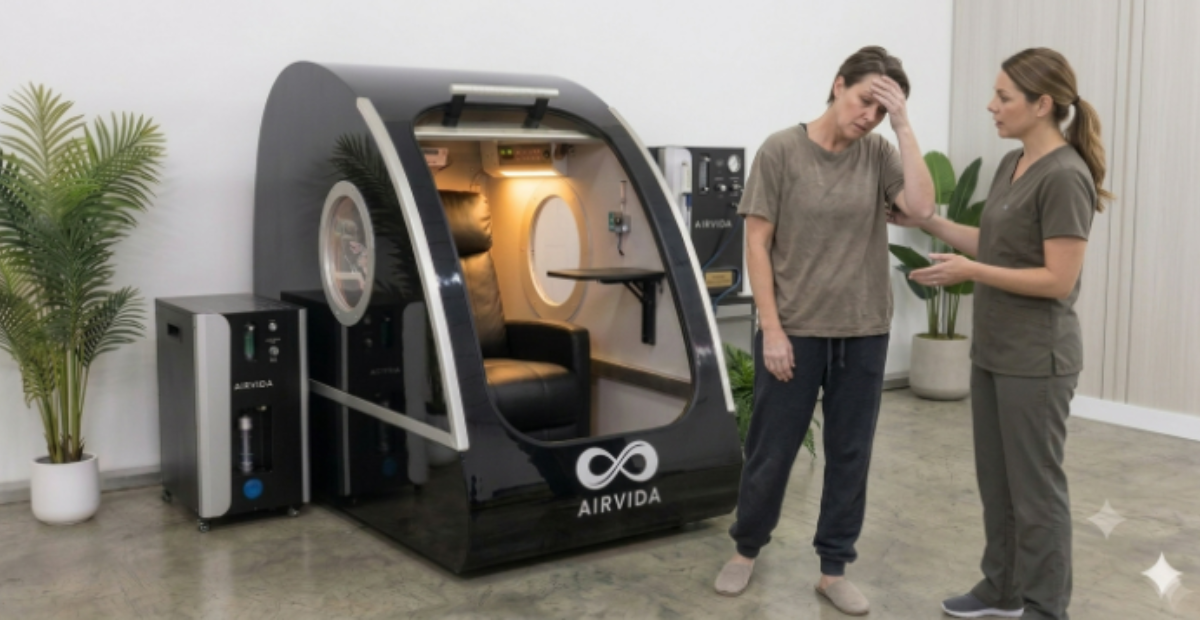
Hyperbaric oxygen therapy (HBOT) is a treatment in which you breathe concentrated oxygen inside a pressurized chamber, and emerging research suggests it may reduce fatigue severity, improve physical functioning, and restore abnormal brain connectivity in patients with myalgic encephalomyelitis/chronic fatigue syndrome (ME/CFS). A 2025 prospective cohort study from Charité – Universitätsmedizin Berlin found that 30 ME/CFS patients who completed 40 HBOT sessions showed statistically significant improvements in fatigue, pain, exercise capacity, and information processing speed, with 76.67% reporting subjective improvement and no major adverse events. Evidence remains promising but preliminary, and randomized controlled trials are still underway.
Key Takeaways
-
HBOT involves breathing high-concentration oxygen in a pressurized environment, and recent research suggests it may meaningfully reduce fatigue and pain in ME/CFS patients.
-
A 2025 Berlin cohort study found that the Chalder Fatigue Scale improved significantly after 40 HBOT sessions (p < 0.001, effect size g = -0.87), alongside gains in physical function and cognitive speed.
-
Post-exertional malaise (PEM), a hallmark ME/CFS concern, did not worsen during the Berlin trial, making HBOT a candidate worth investigating for this population specifically.
-
Brain imaging showed that treatment responders experienced greater reductions in thalamic hyperconnectivity, pointing to a possible neurological mechanism behind symptom relief.
-
The first double-blind, placebo-controlled randomized controlled trial (RCT) for HBOT in ME/CFS is currently recruiting, with primary completion expected in June 2027.
-
HBOT is not yet a standard treatment for ME/CFS, and clinical decisions should be made in partnership with a qualified healthcare provider familiar with the current evidence.
What Is Hyperbaric Oxygen Therapy, and How Does It Work for Chronic Fatigue?
Hyperbaric oxygen therapy is a medical intervention in which you breathe near-pure oxygen inside a sealed chamber pressurized above normal atmospheric levels, which dramatically increases the amount of oxygen dissolved in your blood plasma and delivered to tissues. In the context of chronic fatigue, researchers theorize that this oxygen surplus may address underlying biological abnormalities, including mitochondrial dysfunction, neuroinflammation, and impaired cellular energy production, each of which has been implicated in ME/CFS pathophysiology.
The proposed mechanisms include promoting neuroplasticity, reducing systemic inflammation, and correcting abnormal patterns of brain connectivity. A 2025 study published in the Journal of Translational Medicine identified thalamic hyperconnectivity as a measurable neurological marker in ME/CFS patients, one that appeared to normalize in treatment responders after 40 HBOT sessions. This suggests the therapy may influence not just symptoms but underlying brain network dysregulation.
The bottom line is that HBOT's working theory for chronic fatigue centers on correcting oxygen delivery deficits and neuroinflammation, though the precise mechanisms remain an area of ongoing investigation.
What Does the Latest Research Say About HBOT and ME/CFS?

The most current and largest observational study on this topic is the 2025 Charité – Universitätsmedizin Berlin cohort study, which enrolled 30 patients with post-infectious ME/CFS who received 40 HBOT sessions. Published in the Journal of Translational Medicine, the study reported the following key outcomes:
Fatigue and Pain Outcomes:
-
Chalder Fatigue Scale improved significantly (p < 0.001, g = -0.87)
-
SF-36 pain subscale improved (p = 0.002, g = 0.79)
-
Physical functioning subscale improved (g = 0.71, p = 0.006)
Physical and Cognitive Outcomes:
-
Exercise capacity improved (g = 0.66, p < 0.05)
-
Muscle strength improved (g = 0.40, p < 0.05)
-
Information processing speed improved (g = 0.52, p < 0.05)
Safety and Tolerability:
-
No major adverse events were reported
-
PEM did not worsen during the treatment course
-
76.67% of participants (23 out of 30) reported subjective improvement
An earlier study indexed on PubMed enrolled 16 patients diagnosed with CFS using the Fukuda criteria and administered 15 sessions over three consecutive weeks. Results from that smaller trial were more modest, illustrating that session number, pressure protocol, and patient selection may all influence outcomes. The research field continues to refine which patient subgroups benefit most.
The key point is that the 2025 Berlin study represents the strongest observational evidence to date, though its non-randomized design means results must be interpreted with appropriate caution.
Hyperbaric Collections You May Want to Shop

How Does HBOT Compare to Other Approaches for Chronic Fatigue?
There is currently no universally accepted curative treatment for ME/CFS, and available approaches focus primarily on symptom management. The table below summarizes how HBOT compares to other commonly discussed approaches based on current evidence.
|
Approach |
Fatigue Evidence Level |
PEM Risk |
Neurological Effect |
Current Trial Status |
|
HBOT (40 sessions) |
Moderate (2025 cohort) |
Low (Berlin data) |
Thalamic connectivity change |
Active RCT recruiting |
|
Graded Exercise Therapy |
Controversial |
High (worsens PEM in some) |
Not established |
Not recommended for ME/CFS |
|
Cognitive Behavioral Therapy |
Limited for physical symptoms |
Neutral |
Not established |
Available clinically |
|
Low-dose Naltrexone |
Preliminary positive signals |
Low |
Anti-inflammatory proposed |
Small trials only |
|
Pacing / Energy Management |
Widely recommended |
Protective |
None established |
Standard of care recommendation |
HBOT stands out because it is the only approach with documented neuroimaging changes tied to symptom improvement in the current ME/CFS literature. However, pacing and energy management remain the most widely supported strategies for day-to-day symptom control, given their safety profile. No single therapy has been validated as curative.
The bottom line is that HBOT occupies an emerging evidence tier, more supported than many alternatives but not yet confirmed through gold-standard randomized trials.
What Are the Ongoing Clinical Trials, and Why Do They Matter?
Two significant clinical trials currently define the frontier of HBOT research for ME/CFS, and understanding their designs helps you assess how much the evidence base may shift in the next few years.
Trial 1: Assaf-Harofeh Medical Center (Israel) Listed on ClinicalTrials.gov, this is described as the first prospective, randomized, double-blind, sham-controlled study of HBOT in ME/CFS. It is currently recruiting as of 2026, with a primary completion date of June 2027. Because it uses a sham control, it can directly test whether the pressurized oxygen itself, rather than the chamber experience, produces the observed benefits.
Trial 2: Charité – Universitätsmedizin Berlin (NCT06118138) This observational study, listed on ClinicalTrials.gov and funded by Germany's Federal Ministry of Education and Research, was completed in December 2025. Its published results, discussed above, provide the most detailed symptom and imaging data currently available, though without randomization, confounding factors cannot be fully excluded.
A 2025 International ME/CFS Research Conference presentation noted that an earlier Israeli randomized trial showed improvement after 40 sessions, while a Swedish study using only 10 sessions showed no positive effects, suggesting that session count may be a critical variable in trial design. These findings underscore why the upcoming double-blind RCT is particularly significant for establishing definitive conclusions.
The key point is that the field is actively generating higher-quality evidence, and results from the 2027 RCT will be pivotal for clinical guidance.
Does HBOT Worsen Post-Exertional Malaise in ME/CFS Patients?

Post-exertional malaise is a symptom pattern in which even minor physical or cognitive exertion triggers a significant worsening of ME/CFS symptoms, sometimes lasting days or weeks, making it a primary safety consideration when evaluating any new intervention. This concern is why many researchers and clinicians have historically been cautious about recommending physically demanding or physiologically stimulating therapies for this population.
The 2025 Berlin cohort study directly addressed this concern. Among the 30 ME/CFS patients with moderate to severe symptoms who completed 40 HBOT sessions, no adverse events were reported and PEM did not worsen as a result of therapy. This finding is clinically meaningful because it suggests that the passive nature of HBOT, where you lie in a chamber rather than engage in physical exertion, may allow delivery of a physiological intervention without triggering the exertion-related relapse common to other approaches.
That said, individual responses to HBOT vary. The Berlin study documented heterogeneous response patterns: some patients improved across physical function, fatigue, cognition, and pain, while others showed improvement limited to cognition and pain only. You should discuss your symptom profile and PEM triggers with a healthcare provider before beginning any HBOT protocol.
The bottom line is that current data does not indicate HBOT worsens PEM, but individual variability means clinical supervision remains essential.
What Is the Connection Between HBOT, Brain Function, and Chronic Fatigue?
One of the most compelling findings from recent research is the link between HBOT and measurable changes in brain connectivity in ME/CFS patients. The 2025 Berlin study used neuroimaging to assess thalamic hyperconnectivity, an abnormal pattern of brain signaling that has been identified as a potential neurological signature of ME/CFS.
Patients classified as responders, defined as those achieving a 10-point or greater improvement in the SF-36 physical functioning subscale, showed significantly greater reductions in thalamic hyperconnectivity than non-responders (p < 0.001). This correlation between brain network normalization and functional improvement adds a mechanistic dimension to the clinical data. It also raises the possibility that neuroimaging could eventually be used to identify which patients are most likely to benefit before treatment begins.
This neurological angle is consistent with broader research exploring brain-based contributors to ME/CFS, including neuroinflammation and dysregulated autonomic function. Whether HBOT's effects on brain connectivity are causal or correlational remains an area of ongoing investigation.
The key point is that HBOT appears to influence measurable brain network abnormalities in ME/CFS, which may explain at least part of the fatigue and cognitive symptom improvement observed clinically.
Hyperbaric Chambers You May Want to Shop
Explore More


Can HBOT Be Combined With Other Recovery Modalities?
HBOT is not the only intervention being explored for fatigue, neurological recovery, and cellular wellness. Some patients with chronic fatigue conditions are exploring complementary modalities alongside HBOT, including photobiomodulation-based approaches such as red light therapy. If you are interested in exploring light-based recovery tools as part of a broader wellness strategy, options include red light therapy beds for sale and devices positioned for anti-aging red light therapy.
Some users also explore red light modalities for skin rejuvenation or as a complement to physical wellness programs, including those focused on red light therapy for weight loss. None of these approaches replace clinical treatment for ME/CFS, and their use alongside HBOT has not been studied in the ME/CFS population specifically.
Any combination protocol should be reviewed with a qualified healthcare professional. Evidence for individual modalities varies, and stacking interventions without guidance may complicate interpretation of what is or is not helping.
The bottom line is that complementary modalities may play a supporting role, but they should be layered thoughtfully and never used as a substitute for evidence-informed medical care.
What Should You Know About HBOT Safety and Session Protocols?
HBOT, when supervised by qualified healthcare professionals, is considered to have a favorable safety profile, with potential side effects primarily stemming from the effects of increased pressure rather than oxygen toxicity at typical therapeutic pressures. The most commonly reported side effects include ear or sinus discomfort during pressurization, similar to the sensation you experience when a plane descends, and temporary visual changes. Serious complications are rare in supervised clinical settings.
The Berlin cohort study used 40 sessions as its protocol, and the comparison to the 10-session Swedish study, which found no benefit, suggests that treatment duration is a meaningful variable. In the Undersea and Hyperbaric Medicine Journal study indexed on PubMed, 16 CFS patients received 15 sessions over three weeks, with a different pressure profile and fewer sessions than the Berlin protocol. These differences make cross-study comparison difficult and underscore why protocol standardization is a priority for ongoing research.
It is also worth noting that HBOT has established applications for other conditions, including hyperbaric chamber use for decompression sickness, where the physiological principles of pressurized oxygen delivery are well documented. Familiarity with these established applications helps contextualize how HBOT is being translated into new investigational uses like ME/CFS.
The bottom line is that HBOT appears safe in supervised clinical settings, but session number, pressure level, and patient screening are all variables that influence both safety and outcomes.
What Is the Best Current Approach to Managing Chronic Fatigue?

Managing chronic fatigue, particularly in the context of ME/CFS, currently involves a combination of symptom-targeted strategies rather than a single definitive treatment. The most widely supported approach remains pacing, which means carefully managing your energy expenditure to avoid triggering PEM, paired with individualized symptom management for sleep dysfunction, pain, and cognitive difficulties.
HBOT represents an emerging option with a growing evidence base, but it is not yet a standard of care recommendation. If you are considering it, working with a provider who has experience with ME/CFS and access to a clinical HBOT facility is the appropriate starting point. Keeping detailed symptom logs before, during, and after any intervention helps you and your provider evaluate whether the treatment is producing meaningful benefit in your individual case.
The bottom line is that chronic fatigue management is currently multimodal and individualized, with HBOT occupying a promising but not yet confirmed position in the therapeutic landscape.
Frequently Asked Questions
Can hyperbaric oxygen therapy help with fatigue?
Hyperbaric oxygen therapy may help reduce fatigue in certain patients, particularly those with ME/CFS, based on emerging clinical data. A 2025 cohort study found statistically significant improvements on the Chalder Fatigue Scale after 40 HBOT sessions. Results vary by individual, and randomized controlled trials are still ongoing.
What is the best treatment for chronic fatigue?
There is no single universally accepted best treatment for chronic fatigue or ME/CFS as of 2026. Pacing and energy management remain the most widely recommended strategies for symptom control, while HBOT, low-dose naltrexone, and other interventions are actively being studied. Treatment should be individualized in consultation with a knowledgeable healthcare provider.
Can oxygen therapy help with chronic fatigue syndrome?
Oxygen therapy in the form of HBOT has shown promising results for chronic fatigue syndrome in recent studies. A 2025 Berlin cohort study found significant improvements in fatigue, pain, physical functioning, and cognitive speed in ME/CFS patients after 40 HBOT sessions. Definitive evidence from randomized controlled trials is still pending.
How long can a person stay in a hyperbaric chamber?
A standard HBOT session typically lasts 60 to 90 minutes, depending on the protocol and clinical indication. In ME/CFS research studies, patients completed 40 sessions over the course of the treatment period without major adverse events. Session duration and total number of sessions should be determined by a qualified clinician.
Is oxygen good for fatigue?
Increased oxygen delivery through HBOT appears to benefit fatigue in certain contexts, particularly in conditions like ME/CFS where cellular energy production and neurological function may be compromised. The 2025 Berlin study found that ME/CFS patients showed significant fatigue score improvements following 40 pressurized oxygen sessions. Normal ambient oxygen at standard atmospheric pressure does not produce the same physiological effect as pressurized HBOT.