


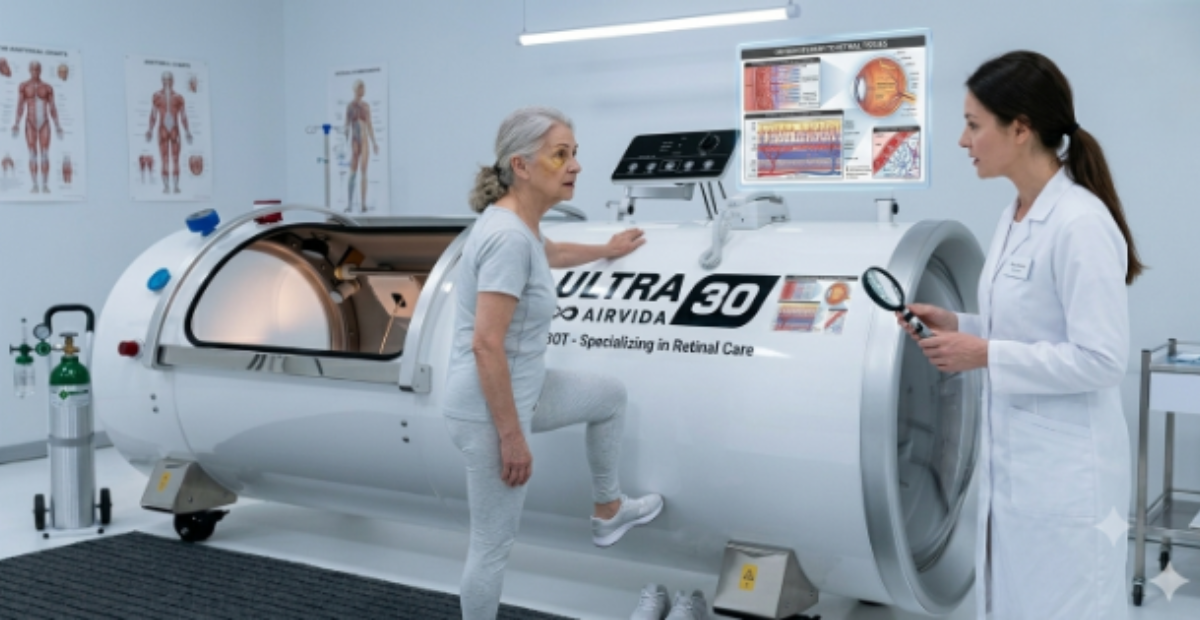
A hyperbaric chamber for macular degeneration may help improve oxygen delivery to retinal tissues, which is why some researchers and patients have explored its potential role in supporting eye health. While HBOT is not considered a standard treatment for macular degeneration, ongoing interest continues around its ability to increase oxygen availability to damaged areas of the eye.
Macular degeneration is one of the leading causes of vision loss among older adults. As the condition progresses, it affects the macula, the central part of the retina responsible for sharp, detailed vision. This can make everyday activities such as reading, driving, and recognizing faces increasingly difficult.
Because conventional treatments may not fully restore lost vision, many patients look for complementary approaches that could support retinal function. One option that often enters the discussion is the use of hyperbaric oxygen therapy (HBOT).
In this guide, we'll explore how HBOT works, what current evidence suggests, who may be a suitable candidate, and how it compares with other available treatment options.
Understanding Macular Degeneration

Before discussing HBOT, it helps to understand what macular degeneration is and why oxygen delivery matters.
Macular degeneration occurs when the macula begins to deteriorate over time. There are two primary forms:
|
Type |
Characteristics |
Progression |
|
Dry Macular Degeneration |
Thinning of macular tissues and accumulation of drusen deposits |
Usually develops gradually |
|
Wet Macular Degeneration |
Abnormal blood vessels grow beneath the retina and leak fluid |
Often progresses more rapidly |
The retina requires a constant supply of oxygen and nutrients to function properly. When circulation becomes compromised or retinal cells begin to deteriorate, vision quality may decline.
This relationship between oxygen and retinal health is one reason some medical professionals have investigated whether increased oxygen availability could provide benefits for certain eye conditions. Insights from resources like does HBOT affect diabetes or blood sugar? Also highlight how oxygen therapy may influence broader systemic processes, reinforcing its potential relevance across multiple aspects of patient care.
Hyperbaric Collections You May Want to Shop


How Hyperbaric Oxygen Therapy Works
Hyperbaric oxygen therapy involves breathing nearly pure oxygen while inside a pressurized chamber.
Under increased atmospheric pressure, the body can absorb significantly more oxygen than it would under normal conditions. This oxygen-rich blood then travels throughout the body, reaching tissues that may have reduced oxygen availability.
The process may help support:
✅ Oxygen delivery to tissues
✅ Cellular repair mechanisms
✅ Reduced inflammation in certain conditions
✅ Blood vessel function
✅ Healing responses
The theory behind using a hyperbaric chamber for macular degeneration centers on the possibility that enhanced oxygenation may temporarily support retinal cells that are under stress.
For individuals interested in professional HBOT options, Airvida offers access to specialized chamber solutions through its collection: HBOT Flower Mound.
Why Researchers Have Studied HBOT for Eye Conditions
The retina is among the most oxygen-demanding tissues in the human body.
When retinal cells experience reduced oxygen availability, cellular performance may decline. Researchers have therefore explored whether increasing oxygen delivery could improve retinal function or slow deterioration.
Several eye conditions have been investigated in relation to HBOT, including:
-
Retinal artery occlusion
-
Radiation-induced eye damage
-
Diabetic retinopathy
-
Ischemic retinal diseases
-
Macular degeneration
The primary hypothesis suggests that higher oxygen levels may help support retinal metabolism, especially in areas where circulation is compromised.
However, it's important to note that research findings have been mixed, and HBOT is not currently considered a first-line treatment for age-related macular degeneration.
Hyperbaric Chambers You May Want to Shop
Explore More


Potential Benefits of HBOT for Macular Degeneration
Although more large-scale studies are needed, several potential benefits have been discussed in medical literature.
Improved Oxygen Availability
The retina depends heavily on oxygen to maintain visual function.
HBOT may temporarily increase oxygen concentrations reaching retinal tissues, potentially supporting cells that remain viable but are functioning below optimal levels.
Support for Cellular Function
Cells that receive adequate oxygen can perform metabolic processes more efficiently.
In theory, increased oxygen availability may help retinal cells maintain their function longer, although this effect can vary greatly between individuals.
Potential Visual Improvements
Some small studies and patient reports have documented temporary improvements in:
-
Visual acuity
-
Contrast sensitivity
-
Reading ability
-
Central vision performance
Results are not universal, and improvements may not be permanent.
Enhanced Circulation Support
Oxygen-rich blood can contribute to healthier tissue environments and may support existing circulation networks within the eye.
This remains an area of ongoing research rather than an established clinical benefit.
What Current Research Says

Research regarding HBOT and macular degeneration remains limited compared with conventional treatments.
Some studies have reported modest visual improvements in selected patients, particularly during early stages of disease progression. Other studies have found little long-term benefit.
Several factors affect outcomes:
|
Factor |
Potential Impact |
|
Type of macular degeneration |
Dry and wet forms may respond differently |
|
Disease severity |
Earlier stages may show greater responsiveness |
|
Patient age |
Individual health factors influence outcomes |
|
Treatment frequency |
Protocols vary significantly |
|
Overall retinal health |
Existing damage affects potential improvement |
One challenge in evaluating HBOT is that studies often involve small participant groups and differing treatment protocols.
As a result, major ophthalmology organizations generally consider HBOT an investigational or complementary approach rather than a standard treatment.
Who Might Consider HBOT?
HBOT is not suitable for every patient with macular degeneration.
Some individuals explore HBOT when:
-
Conventional treatments have provided limited results
-
They want to pursue complementary therapies
-
Their healthcare provider believes additional oxygen support may be worth evaluating
-
They are participating in clinical research programs
The decision should always involve consultation with an ophthalmologist and healthcare professionals familiar with both retinal disease and hyperbaric medicine.
A thorough eye examination remains essential before pursuing any alternative or adjunctive treatment strategy.
How HBOT Compares to Traditional Treatments
Traditional treatments remain the foundation of macular degeneration management.
Dry Macular Degeneration
Common approaches include:
-
AREDS nutritional supplements
-
Lifestyle modifications
-
Smoking cessation
-
Healthy diet
-
Regular monitoring
Wet Macular Degeneration
Treatment often involves:
-
Anti-VEGF injections
-
Laser therapy
-
Photodynamic therapy
-
Ongoing retinal specialist care
The following table compares general treatment approaches:
|
Treatment |
Primary Goal |
Current Standard of Care |
|
AREDS Supplements |
Slow progression |
Yes |
|
Anti-VEGF Injections |
Reduce abnormal vessel growth |
Yes |
|
Laser Treatments |
Target leaking vessels |
Yes |
|
HBOT |
Increase tissue oxygenation |
Complementary / Investigational |
You may also find value in learning more about Can HBOT Treat Neurological Conditions?
Risks and Considerations
While HBOT is generally considered safe when administered appropriately, it is not completely risk-free.
Potential side effects may include:
✅ Ear pressure discomfort
✅ Temporary vision changes
✅ Sinus pressure
✅ Fatigue after treatment
✅ Rare oxygen toxicity complications
Many vision-related changes associated with HBOT are temporary and resolve after treatment ends.
Patients with existing eye conditions should discuss these possibilities carefully with their healthcare providers.
Understanding both the potential benefits and limitations helps establish realistic expectations.
Lifestyle Habits That Support Eye Health

Whether or not HBOT is part of a treatment plan, healthy lifestyle choices remain critical for managing macular degeneration.
Nutrition
Foods rich in antioxidants may help support retinal health:
-
Leafy green vegetables
-
Colorful fruits
-
Fish rich in omega-3 fatty acids
-
Nuts and seeds
Smoking Cessation
Smoking is one of the strongest risk factors associated with progression of age-related macular degeneration.
Regular Eye Exams
Routine monitoring helps detect changes early and allows timely intervention.
Physical Activity
Regular exercise supports healthy circulation throughout the body, including the eyes.
Blood Pressure Management
Healthy vascular function contributes to retinal health and overall visual wellness.
The Future of HBOT and Vision Research

Interest in oxygen-based therapies continues to grow.
Researchers are studying:
-
Retinal oxygen metabolism
-
Neuroprotection strategies
-
Cellular regeneration approaches
-
Combined therapies involving HBOT
-
New technologies for retinal preservation
As understanding of retinal disease evolves, future studies may better define which patients could benefit most from oxygen-based interventions. For now, HBOT remains an area of promising but developing research rather than a universally accepted treatment for macular degeneration, though some individuals explore hyperbaric oxygen in Bessemer, AL, as part of broader wellness and recovery strategies.
Final Thoughts on Hyperbaric Chamber for Macular Degeneration
The use of a hyperbaric chamber for macular degeneration continues to attract attention because of its ability to increase oxygen delivery throughout the body, including the retina. While some patients have reported visual improvements and researchers continue investigating its potential, HBOT is not currently considered a replacement for conventional macular degeneration treatments.
For individuals exploring additional options to support eye health, discussing HBOT with both an ophthalmologist and hyperbaric specialist can help determine whether it may fit within a broader care strategy. As research advances, the role of a hyperbaric chamber for macular degeneration may become clearer, offering deeper insights into how oxygen therapy could support retinal health and vision preservation.
Frequently Asked Questions
Can a hyperbaric chamber help with macular degeneration?
A hyperbaric chamber may help improve oxygen delivery to retinal tissues, which has led researchers to investigate its potential role in supporting vision health. Some small studies and patient reports have shown temporary improvements in visual function, particularly in certain individuals with early-stage disease. However, HBOT is not currently recognized as a standard treatment for macular degeneration, and results can vary significantly from person to person. Anyone considering HBOT should consult an ophthalmologist before beginning treatment.
What is the most effective treatment for macular degeneration?
The most effective treatment depends on the type of macular degeneration. For wet macular degeneration, anti-VEGF injections remain the gold standard because they help control abnormal blood vessel growth and leakage. For dry macular degeneration, management typically focuses on nutritional support, healthy lifestyle habits, and regular monitoring. Early diagnosis and consistent follow-up care remain the most important factors for preserving vision and slowing disease progression.
Can hyperbaric chamber cause eye problems?
Hyperbaric oxygen therapy can sometimes cause temporary eye-related side effects. Some individuals experience short-term changes in vision, including temporary nearsightedness, after multiple treatment sessions. These effects usually improve after therapy is completed. Serious eye complications are uncommon when HBOT is administered correctly by trained professionals. Patients with existing eye diseases should discuss risks and benefits thoroughly with their healthcare provider before starting treatment.
What is the newest treatment for macular degeneration?
Several newer treatments are expanding options for patients with macular degeneration. Recent advances include longer-lasting anti-VEGF medications, implantable drug delivery systems, and treatments targeting geographic atrophy associated with advanced dry macular degeneration. Researchers are also studying gene therapy, stem cell approaches, and oxygen-based therapies such as HBOT. While these innovations show promise, treatment recommendations should always be based on individual diagnosis and guidance from a retinal specialist.