



A hyperbaric chamber delivers pressurized, high-concentration oxygen that saturates blood plasma and tissues far beyond what normal breathing achieves. For endurance athletes specifically, peer-reviewed research shows repeated sessions can increase VO2max, improve mitochondrial respiration, and reduce post-exercise muscle damage markers, making it a legitimate recovery and performance tool worth understanding in detail.
Key Takeaways
-
Hyperbaric oxygen therapy has been shown in a double-blind, placebo-controlled trial to significantly increase VO2max and anaerobic threshold in middle-aged master athletes compared to a sham control group.
-
A 2022 NIH-published study was the first human trial to demonstrate that hyperbaric oxygen therapy directly improves mitochondrial respiration and increases mitochondrial mass via muscle biopsy evidence.
-
Endurance athletes who use hyperbaric chambers after high-intensity efforts may recover faster by reducing creatine kinase levels, a direct marker of muscle damage, at 24 and 48 hours post-exercise.
-
Current literature suggests sessions at 2.0 to 2.5 atmospheres absolute (ATA) for 90 to 120 minutes, administered at least five days per week, are associated with the greatest benefit, though no universally standardized protocol has been established.
-
Hyperbaric oxygen therapy works through oxygen saturation of tissues rather than hypoxic adaptation, making it mechanistically distinct from altitude training.
-
Session costs typically range from $200 to $500 per session depending on location and facility type.
What Is a Hyperbaric Chamber and How Does It Work for Athletes?
A hyperbaric chamber is a sealed, pressurized vessel that exposes the body to oxygen concentrations and atmospheric pressures above normal sea-level conditions, typically between 1.5 and 3.0 ATA. At these elevated pressures, oxygen dissolves directly into blood plasma rather than relying solely on hemoglobin transport, allowing it to reach tissues that are oxygen-deprived, inflamed, or under metabolic stress. This is the core mechanism that makes hyperbaric oxygen therapy (HBOT) relevant to athletic recovery and performance.
For endurance athletes, the physiological demands of repeated high-intensity training create chronic tissue stress, localized inflammation, and mitochondrial strain. Standard recovery tools address some of these variables, but none increase the dissolved oxygen content of plasma the way pressurized oxygen does. That distinction is why researchers have specifically investigated HBOT as a complementary training tool rather than a replacement for conventional recovery strategies.
The bottom line is that the pressurized oxygen environment creates a uniquely high-delivery system for oxygen that goes beyond what the lungs and hemoglobin can achieve at sea level.
How Does Hyperbaric Oxygen Therapy Affect VO2max and Aerobic Capacity?

VO2max is the maximum rate at which your body can consume oxygen during intense exercise, and it is the single most important predictor of endurance performance. A 2022 double-blind, randomized, placebo-controlled trial published in NIH PubMed Central studied 37 middle-aged master athletes (ages 40 to 50) who received 40 sessions of either HBOT at 2.0 ATA with 100% oxygen for one hour, or a sham condition at 1.02 ATA breathing regular air. The HBOT group showed a statistically significant increase in VO2max (p = 0.010, effect size = 0.989) and anaerobic threshold (VO2AT, effect size = 0.837) compared to the sham group.
A separate peer-reviewed study published on NIH PubMed Central evaluated young soccer players who completed 15 hyperbaric-hyperoxic training sessions over three weeks. That study found moderate effect-size improvements in both VO2max and peak power output (PPO) without significant increases in oxidative stress markers. Both findings point in the same direction: repeated hyperbaric oxygen exposure can meaningfully improve aerobic capacity metrics that are directly tied to endurance performance.
It is worth noting that these improvements occurred without the traditional hypoxic stress of altitude training, meaning the adaptation pathway is oxygen-saturation-driven rather than hypoxia-driven. If you are an endurance athlete looking to increase aerobic ceiling without adding training load, this represents a mechanistically distinct option.
The key point is that peer-reviewed trial data shows HBOT can increase VO2max in athletes through a mechanism separate from altitude or interval-based aerobic adaptations.
What Does HBOT Do to Mitochondria in Endurance Athletes?
Mitochondrial function is the biochemical engine of endurance performance, determining how efficiently your muscles convert oxygen into usable energy. The 2022 NIH-published trial cited above was the first human study to use muscle biopsies to directly demonstrate that HBOT improves mitochondrial respiration and increases mitochondrial mass. Specifically, the HBOT group showed significant increases in maximal oxygen phosphorylation capacity (effect size = 1.085, p = 0.04), maximal uncoupled capacity (effect size = 0.956, p = 0.02), and the mitochondrial mass marker MTG (p = 0.0002).
These are not proxy measurements. Muscle biopsy data reflects direct changes in the cellular machinery responsible for aerobic energy production. For an endurance athlete, more mitochondrial mass and higher phosphorylation capacity translates to better fat oxidation, delayed glycolytic fatigue, and improved performance at threshold intensities.
Mitochondrial adaptation is typically a slow process driven by training volume and intensity over months. The findings from this trial suggest that HBOT may accelerate or augment mitochondrial biogenesis in a way that complements structured endurance training. This remains an area of ongoing investigation, and longer-term trials with larger samples are needed to confirm the durability of these adaptations.
The bottom line is that HBOT produces measurable, biopsy-confirmed improvements in mitochondrial function, which is a key limiting factor in endurance performance.
Hyperbaric Collections You May Want to Shop

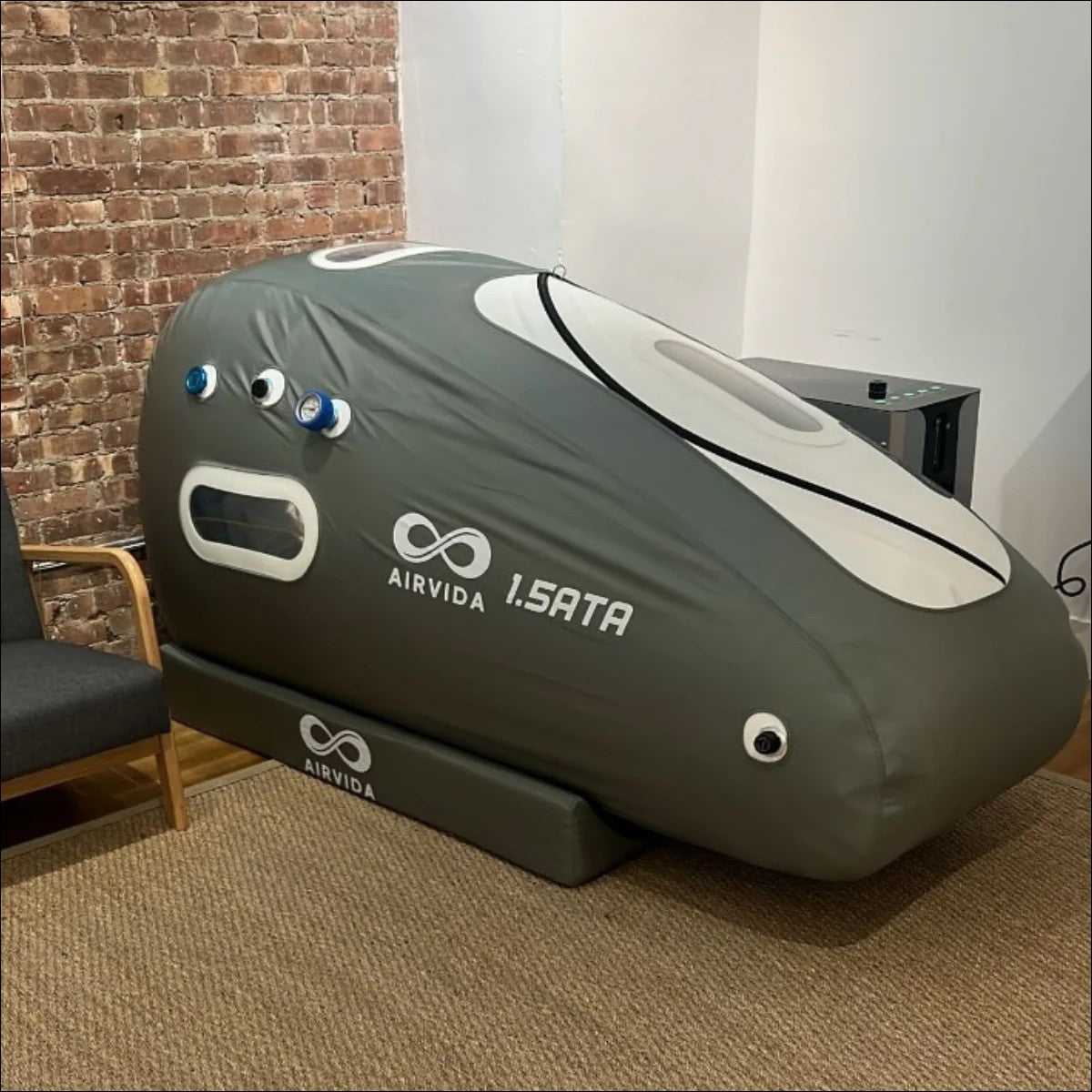
How Does a Hyperbaric Chamber Accelerate Muscle Recovery After Hard Training?
Recovery after high-intensity endurance efforts is limited by muscle damage, inflammation, and metabolic waste clearance. Full physiological recovery after a high-intensity match or race effort can take up to 72 hours, a timeframe that often conflicts with congested training or competition schedules and raises injury risk. HBOT addresses several of these recovery variables simultaneously by flooding damaged tissue with oxygen, which supports cellular repair processes and reduces inflammatory signaling.
Research has shown that athletes using hyperbaric oxygen immediately after exercise demonstrated significantly lower creatine kinase levels, a direct biomarker of muscle fiber damage, at both 24 and 48 hours post-exercise compared to controls. Lower creatine kinase levels at those timepoints indicate faster structural repair of muscle tissue. A 2024 double-blind randomized controlled trial (Gušić et al., published in Frontiers in Physiology) examined HBOT recovery specifically in football players after match play and added to the body of evidence supporting faster post-exercise recovery with HBOT versus sham conditions.
A 2025 review in the Turkish Journal of Sports Medicine also confirmed that HBOT reduces inflammation markers in athletes with soft tissue injuries, enabling earlier return to training. For endurance athletes training at high weekly volumes, even a modest reduction in recovery time between sessions compounds into a significant training advantage over a season.
The key point is that HBOT shortens effective recovery time by reducing muscle damage markers and inflammation, both of which directly limit how quickly you can train hard again.
What Is the Difference Between Hyperbaric Oxygen Therapy and Altitude Training?
Altitude training and hyperbaric oxygen therapy are often compared because both involve manipulating the oxygen environment, but they work through opposite mechanisms. Altitude training reduces ambient oxygen levels, forcing the body to adapt by increasing red blood cell production and erythropoietin (EPO) secretion through hypoxic stress. HBOT increases ambient oxygen levels under pressure, saturating plasma with dissolved oxygen without triggering hypoxic adaptation pathways.
|
Feature |
Altitude Training |
Hyperbaric Oxygen Therapy |
|
Oxygen environment |
Low oxygen (hypoxia) |
High oxygen (hyperoxia) |
|
Primary adaptation |
Increased RBC and EPO |
Mitochondrial and tissue-level oxygen efficiency |
|
When applied |
During training blocks |
Post-exercise or between sessions |
|
Effect on VO2max |
Well-established increase |
Demonstrated increase in RCTs |
|
Oxidative stress risk |
Moderate to high |
Low (based on current evidence) |
|
Accessibility |
Requires travel or altitude tent |
Available in clinics or personal chambers |
|
Session cost |
Variable |
Roughly $200 to $500 per session |
The practical implication is that altitude training and HBOT are not interchangeable but may be complementary. Altitude training stresses the oxygen transport system to force upward adaptation. HBOT restores and enhances the same system through hyperoxic saturation, which supports recovery and mitochondrial function without adding physiological stress. For athletes who cannot spend extended time at altitude, or who are in a competition phase where hypoxic stress is counterproductive, HBOT offers a distinct alternative.
The bottom line is that HBOT and altitude training target the same performance variables through completely opposite oxygen-manipulation strategies, making them additive rather than redundant tools.
What Protocol Do Endurance Athletes Use in a Hyperbaric Chamber?

A standardized protocol has not yet been universally established across all athletic applications, but current peer-reviewed literature points toward consistent parameters. Based on findings synthesized in the 2025 Turkish Journal of Sports Medicine review, the following framework reflects what research protocols have used and what practitioners cite most often:
Evidence-Informed HBOT Protocol for Endurance Athletes:
-
Pressure level: 2.0 to 2.5 ATA per session
-
Oxygen concentration: 100% oxygen throughout the session
-
Session duration: 90 to 120 minutes per session
-
Frequency: At least five sessions per week during an intervention block
-
Total sessions: The NIH 2022 trial used 40 total sessions; most reviewed protocols use 20 to 40 sessions
-
Timing: Post-exercise application appears most commonly studied for recovery purposes; pre-competition use varies by athlete goal
-
Monitoring: Baseline and follow-up fitness testing (VO2max, power output) recommended to track individual response
Athletes exploring chamber options can find professional-grade setups at locations such as hyperbaric chambers in Stamford, CT or hyperbaric chambers in Sarasota, FL depending on your region. For those in the Southeast, West Palm Beach hyperbaric chambers offer another regional option, and athletes in the Southwest can access hyperbaric chambers in Round Rock, TX.
The key point is that while no single protocol is universally standardized, the current research consistently points to sessions at 2.0 to 2.5 ATA for 90 to 120 minutes, at high weekly frequency, as the most beneficial approach.
Hyperbaric Chambers You May Want to Shop
Explore More


Can Hyperbaric Chambers Support Cognitive Performance in Athletes?
Cognitive function is an underrecognized performance variable in endurance sports, affecting pacing decisions, tactical execution, and mental fatigue management. A 2024 review in Frontiers in Neurology identified HBOT as a legitimate neuromodulatory intervention with documented effects on cognitive function, reaction time, and decision-making relevant to athletic performance. These cognitive effects are likely related to improved cerebral oxygen delivery and reduced neuroinflammation.
For endurance athletes, cognitive fatigue accumulates during long events and can impair decision-making and perceived exertion regulation independent of physical fatigue. If HBOT supports faster neurological recovery between sessions, it may extend the range at which athletes can maintain high-quality training decisions across a heavy block. This area remains under active investigation, and direct studies linking HBOT to endurance-specific cognitive performance outcomes are still limited.
The bottom line is that early evidence supports a cognitive recovery component to HBOT that may benefit endurance athletes beyond the purely physical recovery effects.
Who Should Consider a Hyperbaric Chamber and Who Should Avoid It?
Hyperbaric oxygen therapy is appropriate for healthy endurance athletes seeking to augment recovery and aerobic adaptation, but it is not suitable for everyone. If you are considering HBOT for athletic optimization, you should consult a qualified physician before beginning, particularly if you have any of the following conditions:
Conditions that require medical clearance or may contraindicate HBOT:
-
Untreated pneumothorax (collapsed lung)
-
Active upper respiratory infections or sinusitis that prevent pressure equalization
-
Uncontrolled seizure disorders
-
Claustrophobia severe enough to prevent tolerance of a pressurized enclosure
-
Certain pulmonary conditions affecting air trapping in the lungs
-
Pregnancy (evidence is currently insufficient to confirm safety for athletic use)
-
Recent ear surgery or perforated eardrums
For athletes who are healthy and cleared by a physician, the evidence-based risk profile for HBOT at 2.0 to 2.5 ATA is generally considered acceptable in research settings. If you are a performance-oriented athlete interested in biohacking approaches, the best hyperbaric chamber for biohackers resource provides additional context on chamber selection and individual use considerations.
The key point is that HBOT is appropriate for most healthy athletes with physician clearance but carries specific contraindications that require professional evaluation before starting a protocol.
Is a Hyperbaric Chamber Worth It for Endurance Athletes?

The research case for hyperbaric oxygen therapy in endurance athletes is more substantive than it is for many popular recovery modalities. Peer-reviewed, controlled trials have confirmed improvements in VO2max, anaerobic threshold, mitochondrial respiration, and muscle damage markers. The 2022 NIH trial alone, with its biopsy-confirmed mitochondrial data and statistically significant VO2max changes, provides a stronger evidence base than most athletes expect from a recovery technology.
The practical considerations are cost and accessibility. At $200 to $500 per session, a full protocol of 40 sessions represents a significant financial commitment. Regional clinic access varies, though purpose-built facilities are increasingly available across the United States. Personal chamber options exist for athletes seeking at-home access, though chamber selection and pressure capabilities vary widely.
The bottom line: hyperbaric oxygen therapy is a research-supported tool for endurance athletes that can increase VO2max, improve mitochondrial function, and accelerate post-exercise recovery when used consistently at appropriate pressures.
Frequently Asked Questions
Is a hyperbaric chamber good for athletes?
Yes, hyperbaric chambers are beneficial for athletes based on peer-reviewed evidence. Controlled trials have shown improvements in VO2max, anaerobic threshold, mitochondrial respiration, and post-exercise muscle damage markers. Benefits appear most consistent with repeated sessions at 2.0 to 2.5 ATA over a multi-week protocol rather than single sessions.
Which athletes use hyperbaric chambers?
Endurance athletes, football players, soccer players, and combat sports athletes are among the most commonly studied groups using hyperbaric chambers for recovery and performance. High-profile professional athletes across multiple sports have also adopted HBOT as part of their recovery protocols, and master athletes aged 40 to 50 showed particularly strong VO2max improvements in clinical trials.
Who should avoid hyperbaric chambers?
People with untreated pneumothorax, uncontrolled seizure disorders, severe claustrophobia, certain pulmonary conditions, recent ear surgery, or active upper respiratory infections should avoid hyperbaric chambers or seek medical clearance first. Pregnant individuals should also consult a physician before use. Any athlete with an undiagnosed medical condition should obtain clearance before starting HBOT.
Why do athletes sleep in a hyperbaric chamber?
Athletes sleep in hyperbaric chambers to maximize overnight oxygen delivery to recovering tissues during the body's natural repair cycle. Sleeping in a pressurized environment allows prolonged hyperoxic exposure without requiring active session time, and some athletes use lower-pressure portable chambers for this purpose. Research on this specific application is more limited than on formal clinic-based protocols.
What is the downside of a hyperbaric chamber?
The primary downsides of hyperbaric chambers are cost, time commitment, and limited accessibility. Sessions typically cost $200 to $500 each, and research protocols involve 20 to 40 total sessions, making the total investment substantial. Some individuals also experience ear discomfort from pressure equalization, and mild claustrophobia is a common barrier for new users.