


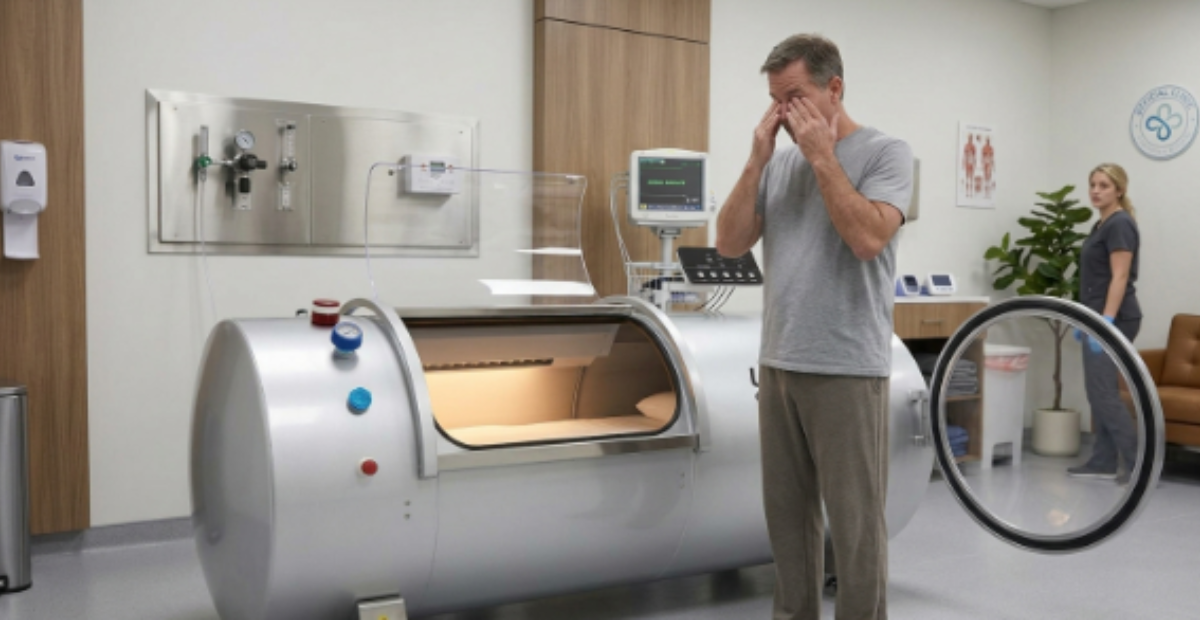
Hyperbaric oxygen therapy (HBOT) can cause several eye-related side effects, the most common being temporary myopia (nearsightedness) and visual changes that typically resolve weeks to months after treatment ends. Less frequently, repeated sessions may accelerate the progression of existing cataracts. These ocular effects result from prolonged exposure to high-concentration oxygen under increased atmospheric pressure, which alters the lens and retinal environment of the eye.
Key Takeaways
-
Temporary myopia is the most frequently reported eye side effect of HBOT, and it typically reverses on its own after treatment concludes.
-
Cataract progression is a documented risk in patients who undergo a high number of HBOT sessions over an extended period.
-
Visual changes during or after HBOT do not usually require stopping treatment, but they should always be reported to your supervising clinician.
-
Oxygen toxicity to the retina is a rare but serious risk, most likely to occur at higher treatment pressures or with underlying eye disease.
-
A pre-treatment ophthalmological evaluation is strongly recommended for anyone planning a prolonged HBOT course.
-
Most eye side effects from HBOT are reversible, making early detection and monitoring the most effective management strategy.
What Eye Side Effects Can Hyperbaric Oxygen Therapy Cause?
Hyperbaric oxygen therapy produces eye side effects through a specific mechanism: sustained hyperoxia (abnormally high oxygen concentration) under elevated atmospheric pressure alters the metabolic and structural environment of ocular tissues. The lens, retina, and optic nerve are each sensitive to these changes in different ways.
The most commonly reported ocular side effect is myopic shift, a change in the refractive power of the eye that makes distant objects appear blurry. This occurs because high oxygen levels cause biochemical changes in lens proteins, temporarily shifting how light is focused on the retina. In most patients, this resolves within six to eight weeks after completing therapy.
Other reported eye side effects include:
-
Visual field changes or scotomas (blind spots)
-
Blurring of vision during or shortly after sessions
-
Increased light sensitivity (photophobia)
-
Accelerated nuclear cataract development with repeated long-term treatment
-
Rarely, signs of central retinal artery involvement at very high pressures
The bottom line is that the majority of eye side effects from HBOT are temporary and dose-dependent, with risk increasing alongside treatment pressure and session frequency.
How Does Hyperbaric Oxygen Therapy Affect the Lens of the Eye?

The crystalline lens of the eye is a particularly vulnerable ocular structure during HBOT because it has no direct blood supply and relies on diffusion for oxygen and nutrient delivery. Under hyperbaric conditions, dissolved oxygen levels in surrounding fluids rise dramatically, exposing the avascular lens to oxygen concentrations far above its normal range.
This hyperoxic exposure promotes oxidative stress within the lens, leading to changes in the solubility and clarity of structural proteins called crystallins. Over time, with enough cumulative sessions, these oxidative changes can manifest as nuclear cataracts, a clouding of the central lens. Studies examining patients who completed more than 150 HBOT sessions have documented accelerated cataract formation in this population.
Importantly, patients who already have early-stage cataracts before starting HBOT may notice faster progression than they would have experienced without treatment. Your clinician should factor this into the risk-benefit discussion before a prolonged HBOT course is prescribed.
The key point is that lens-related side effects are the most structurally significant long-term ocular risk of repeated HBOT, though they are largely avoidable with proper patient selection and monitoring.
Can HBOT Cause Permanent Vision Changes?
Most vision changes caused by HBOT are reversible, particularly the myopic shift that develops during treatment courses. Permanent vision changes are uncommon and are typically associated with extremely high treatment pressures, pre-existing eye conditions, or an unusually high number of cumulative sessions.
Retinal oxygen toxicity is a rare but recognized risk at treatment pressures above standard clinical thresholds. The retina, unlike the lens, is highly vascularized and metabolically active, making it susceptible to free radical damage when oxygen levels reach extreme concentrations. Symptoms of retinal involvement include sudden vision loss, flashing lights, or a curtain-like visual obstruction.
The following factors increase the likelihood of more persistent ocular effects:
-
Pre-existing retinal disease (diabetic retinopathy, macular degeneration)
-
Glaucoma or elevated intraocular pressure
-
Prior retinal surgery
-
High cumulative number of sessions at elevated pressures
-
Concurrent use of medications that sensitize the retina to oxidative stress
The bottom line is that permanent vision changes from HBOT are rare in otherwise healthy eyes, but patients with underlying retinal or optic nerve conditions face a meaningfully higher risk profile.
Hyperbaric Collections You May Want to Shop

What Are the Signs That HBOT Is Affecting Your Vision?
Recognizing early ocular symptoms during a course of HBOT allows for prompt evaluation and, if necessary, a temporary pause or modification of treatment. You should not dismiss visual changes during HBOT as inconsequential, since even reversible conditions warrant documentation and clinical review.
Warning signs that indicate your eyes may be responding to HBOT include:
-
Gradual difficulty seeing distant objects clearly (myopic progression)
-
Blurred vision that persists beyond 24 hours after a session
-
New floaters or flashes of light
-
A gray or dark area appearing in your central or peripheral vision
-
Increased sensitivity to light or glare
-
Eye pain or pressure sensations during or after sessions
-
Sudden, significant vision loss in one or both eyes (seek immediate care)
Any sudden or severe visual symptom should prompt you to contact your treating clinician without delay. Gradual changes, such as slowly worsening distance vision, should be noted and reported at your next appointment.
The key point is that early reporting of any visual symptom gives your care team the information needed to intervene before a reversible condition becomes more complicated.
Comparing Eye Side Effects: Temporary vs. Potentially Persistent
Understanding which ocular side effects resolve on their own versus which may require intervention helps you have a more informed conversation with your clinician.
|
Side Effect |
Onset |
Typically Reversible |
Action Required |
|
Myopic shift |
Gradual, during treatment course |
Yes, within 6-8 weeks post-treatment |
Monitor; update eyeglass prescription temporarily |
|
Visual blurring during sessions |
During or immediately after sessions |
Yes, resolves within hours to days |
Report if persistent beyond 24 hours |
|
Cataract acceleration |
Gradual, with repeated sessions |
No (cataracts do not reverse) |
Pre-treatment baseline evaluation; surgical option if needed |
|
Light sensitivity |
Variable |
Yes, typically self-limited |
Protective eyewear; report if severe |
|
Retinal oxygen toxicity |
Acute |
Possibly, if caught early |
Immediate clinical evaluation; consider treatment pause |
|
Visual field changes |
Variable |
Depends on cause and severity |
Formal visual field testing recommended |
This table illustrates that while most eye side effects from HBOT are manageable and reversible, cataract progression stands out as the primary irreversible structural change associated with long-term, high-frequency treatment.
Who Is at Greatest Risk for Eye Side Effects From Hyperbaric Chambers?
Certain patient profiles carry a higher baseline risk for ocular complications during HBOT, and identifying them before treatment begins is a key component of safe clinical practice. Risk is not uniform across all patients; it is modulated by existing eye health, age, treatment parameters, and systemic conditions.
High-risk patient groups for HBOT-related eye side effects include:
-
Older adults, particularly those over 65, who have age-related lens changes
-
Patients with any stage of diabetic retinopathy
-
Individuals with a history of retinal detachment or retinal surgery
-
Patients with glaucoma or documented optic nerve damage
-
Those with a prior diagnosis of macular degeneration
-
Patients with connective tissue disorders affecting the eyes
If you fall into any of these categories, your clinician may recommend a baseline ophthalmological exam before your first session and periodic re-evaluations during treatment. For patients exploring hyperbaric chamber Pensacola FL options or those seeking hyperbaric chamber Fort Myers FL services, discussing your complete eye health history with your care provider before starting is essential.
The key point is that pre-treatment screening for ocular risk factors is one of the most effective tools available to minimize the likelihood of significant eye side effects.
How Can You Minimize Eye Side Effects During HBOT?

Minimizing eye side effects from HBOT involves a combination of pre-treatment screening, session-level precautions, and active monitoring throughout your treatment course. You do not need to accept ocular complications as an inevitable part of treatment.
Practical steps to reduce your risk of eye side effects during HBOT:
-
Complete a baseline eye exam with an ophthalmologist before starting your first session.
-
Disclose all pre-existing eye conditions, including cataracts, glaucoma, or retinal disease, to your prescribing clinician.
-
Avoid changing your corrective lens prescription during an active HBOT course, as myopic shift makes mid-treatment prescriptions unreliable.
-
Report any new or changing visual symptoms between sessions, not just at scheduled follow-ups.
-
Follow your clinician's prescribed pressure protocol precisely; do not request increased pressures without medical justification.
-
Schedule a post-treatment eye exam approximately eight weeks after completing your HBOT course to document resolution of any myopic shift.
-
If you are undergoing HBOT for a post-surgical indication, review the specific ocular considerations with your surgeon, particularly if the surgery involved the face or eye area. You can also review benefits after plastic surgery to understand the broader role HBOT plays in post-surgical healing.
The bottom line is that active communication with your clinical team and adherence to a structured monitoring plan dramatically reduces the risk of significant or persistent eye side effects.
Should You Avoid HBOT If You Have Pre-Existing Eye Conditions?
Having a pre-existing eye condition does not automatically disqualify you from HBOT, but it does require a more careful risk-benefit analysis and heightened monitoring. The decision to proceed should always be made collaboratively between you, your prescribing physician, and ideally an ophthalmologist familiar with your eye history.
Patients with controlled glaucoma, early-stage cataracts, or a remote history of retinal surgery are often able to complete HBOT with appropriate precautions. Those with active, unstable retinal disease or recent optic nerve injury require more individualized evaluation before proceeding. In some cases, modifying the treatment pressure or session frequency can reduce ocular risk while preserving the therapeutic benefits of HBOT.
Patients exploring hyperbaric chamber Tallahassee, hyperbaric chamber Lubbock TX, or other regional centers should confirm that their chosen facility has a clear protocol for ocular monitoring and a pathway for ophthalmological consultation if visual symptoms arise during treatment.
The key point is that a pre-existing eye condition is a reason for careful planning, not an automatic barrier to HBOT.
Hyperbaric Chambers You May Want to Shop
Explore More


What Should You Do If You Experience Eye Side Effects During HBOT?
If you notice any change in your vision during or after a hyperbaric oxygen session, the appropriate response depends on the type and severity of the symptom. Not all visual changes require stopping treatment, but all of them require documentation and clinical review.
Sudden, severe visual symptoms, including acute vision loss, a sudden dark curtain across your visual field, or new flashing lights, require immediate evaluation and a pause in HBOT until a cause is established. Gradual changes, such as slowly increasing nearsightedness or mild light sensitivity, can typically be managed with monitoring while treatment continues. Your clinician may refer you to an ophthalmologist for formal evaluation, including visual acuity testing, slit-lamp examination, and possibly optical coherence tomography (OCT) imaging of the retina.
Do not self-manage ocular symptoms by reducing session frequency on your own or switching to a different oxygen concentration without medical guidance. Structural eye changes, including retinal changes, may not be visible to you but detectable on examination.
The bottom line is that the right response to HBOT-related eye symptoms is prompt clinical communication, not self-directed treatment modification.
Is HBOT Worth It Despite the Eye Side Effects?

HBOT delivers documented therapeutic benefits for a range of conditions, and for most patients, the ocular side effects are manageable, temporary, and outweighed by clinical benefit. The myopic shift that develops during treatment courses is predictable, reversible, and well-characterized enough that experienced clinicians can prepare patients for it in advance.
The presence of potential eye side effects is not a reason to avoid HBOT if it has been clinically indicated for your condition. It is a reason to ensure that eye health is actively incorporated into your pre-treatment screening, your monitoring plan, and your post-treatment evaluation. With appropriate clinical oversight, the overwhelming majority of patients complete HBOT without lasting ocular harm.
The bottom line: Hyperbaric chamber eye side effects, particularly temporary myopia and, in long-term treatment, potential cataract acceleration, are real but largely predictable and manageable risks that do not outweigh the therapeutic value of HBOT for most clinically appropriate patients.
Frequently Asked Questions
Can hyperbaric oxygen therapy affect your eyes?
Yes, hyperbaric oxygen therapy can affect your eyes, most commonly by causing a temporary myopic shift (nearsightedness) that typically resolves within six to eight weeks after treatment ends. Repeated long-term sessions may also accelerate cataract formation in susceptible individuals, and rare cases of retinal oxygen toxicity have been documented at higher treatment pressures.
What is the most common adverse effect of HBOT?
The most common adverse effect of HBOT is temporary myopia, or nearsightedness, caused by oxidative changes to the crystalline lens during repeated high-oxygen exposure. This refractive change is typically self-resolving and reverses within weeks to months after the treatment course concludes, making it a manageable and expected side effect in patients receiving extended HBOT.
What are the signs of low oxygen in the eyes?
Signs of low oxygen in the eyes include blurred vision, visual field loss, and in severe cases, sudden vision impairment due to retinal ischemia or optic nerve involvement. Low ocular oxygen (hypoxia) can affect the cornea, retina, and optic nerve, and chronic ocular hypoxia is associated with conditions like diabetic retinopathy and ischemic optic neuropathy.
Who should avoid hyperbaric chambers?
People who should avoid hyperbaric chambers include those with untreated pneumothorax, active ear or sinus infections, certain types of lung disease, and uncontrolled high fever. From an ocular standpoint, patients with unstable retinal disease, active optic neuritis, or recent intraocular surgery involving gas bubbles should discuss significant caution or contraindication with their physician before proceeding.
Can being on oxygen affect your eyes?
Yes, prolonged or high-concentration oxygen exposure can affect your eyes by promoting oxidative stress within ocular tissues, particularly the lens and retina. In clinical settings like HBOT, this manifests as temporary myopia and, with extended treatment, potential lens changes. Supplemental oxygen at standard flow rates used in routine medical care carries a much lower ocular risk than the pressurized, high-concentration oxygen used in hyperbaric settings.