


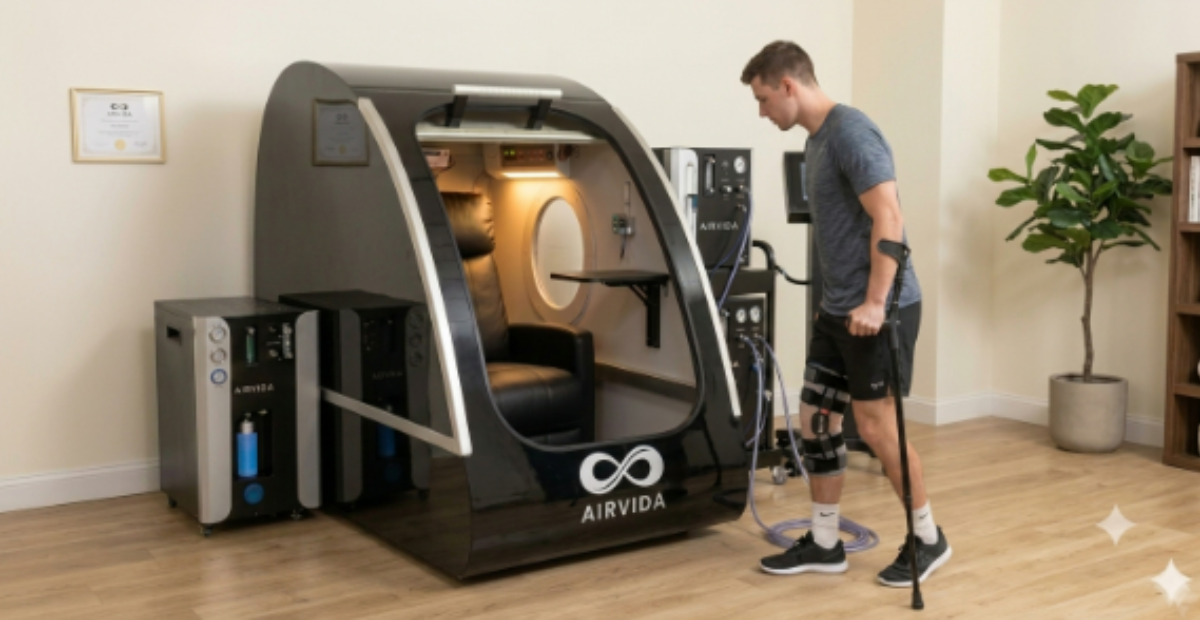
A hyperbaric chamber delivers 100% oxygen at elevated atmospheric pressure, which increases oxygen dissolved in plasma and accelerates delivery to oxygen-deprived tissues. For ACL recovery, early research suggests that hyperbaric oxygen therapy (HBOT) may improve graft maturation, reduce postoperative bone marrow edema, and enhance collagen synthesis during the critical first weeks after reconstruction. The evidence is promising but still emerging, with one human pilot study published and a larger randomized controlled trial actively recruiting as of 2026.
Key Takeaways
-
HBOT delivered at 2.5 ATA for 90 minutes daily was associated with significantly improved MRI signs of graft maturation at 4 months post-surgery in a 2025 human pilot study.
-
A 2024 rabbit study found that HBOT improved graft biomechanical properties, including greater load to failure and stiffness, compared to controls.
-
Bone marrow edema at the graft-bone tunnel interface was significantly lower in the HBOT group compared to controls, suggesting enhanced early integration.
-
Standard ACL reconstruction recovery takes approximately 8 months before return to high-function sport, and HBOT is being studied specifically within this window.
-
A prospective randomized controlled trial (NCT06493851) is actively recruiting through January 2028 to generate higher-quality human evidence.
-
HBOT is not a standalone treatment for ACL injury; it is being evaluated as an adjunct to surgery and structured rehabilitation.
What Is Hyperbaric Oxygen Therapy and How Does It Work for ACL Injuries?
Hyperbaric oxygen therapy (HBOT) is a treatment modality that involves breathing 100% oxygen inside a pressurized chamber at levels above normal atmospheric pressure, typically between 2.0 and 2.5 atmospheres absolute (ATA). This elevated pressure significantly increases the amount of oxygen dissolved in blood plasma, allowing oxygen to reach tissues that have limited blood supply, including healing ligament and bone tunnel interfaces. The ACL graft, particularly in early post-surgical phases, is highly vulnerable to oxygen insufficiency.
The mechanisms relevant to ACL graft healing include enhanced fibroblast proliferation, increased collagen synthesis, improved angiogenesis, and reduced tissue edema. These cellular processes are all central to the "ligamentization" phase, during which a tendon graft remodels into functional ligament tissue. HBOT creates a hyperoxic environment that supports each of these biological processes simultaneously.
Research published in the Turkish Journal of Sports Medicine (2025) found that HBOT-treated groups at 2.5 ATA displayed significantly higher Type I procollagen and tissue inhibitors of metalloproteinases (TIMPs) gene expression compared to controls. TIMPs suppress enzymes that break down collagen, meaning HBOT may both build structural protein and protect it from degradation. The key point is that HBOT targets multiple healing pathways simultaneously rather than a single mechanism.
What Does the Research Show About HBOT After ACL Reconstruction?

The current body of evidence on HBOT for ACL reconstruction consists of preclinical animal studies, one human pilot cohort study, and one active randomized controlled trial, placing it in the category of emerging, not yet established, adjunct therapy. The most informative human study to date was published in 2025 via PubMed Central (PMC12921153), examining MRI-based graft healing in patients who received HBOT following hamstring autograft ACL reconstruction.
In that cohort study, HBOT was administered once daily at 2.5 ATA for 90-minute sessions, with each patient completing 5 sessions within the first 10 days after surgery. Bone marrow edema adjacent to the graft-bone tunnel interface was significantly lower in the HBOT group compared to controls (P = .029), a finding that indicates more advanced early graft integration. Graft signal intensity on MRI, which reflects how completely a graft has matured, was also meaningfully lower in the HBOT group at 4 months.
Supporting animal data come from a 2024 Journal of Orthopaedic Research study in rabbits, which found that adjuvant HBOT improved graft maturation and integration, reduced tunnel widening, and enhanced biomechanical properties including load to failure and stiffness. The rabbit protocol used 100% oxygen at 2.5 ATA for 2 hours daily, starting the first day after surgery. The bottom line is that both human and animal studies consistently point toward improved early graft healing with adjuvant HBOT, though large-scale randomized human trials are still needed.
Hyperbaric Collections You May Want to Shop

How Does a Hyperbaric Chamber Compare to Other ACL Recovery Adjuncts?
The table below summarizes the current evidence status of common adjunct therapies being studied alongside standard ACL rehabilitation:
|
Adjunct Therapy |
Proposed Benefit |
Current Evidence Level |
|
HBOT |
Graft maturation, edema reduction, collagen synthesis |
Emerging: 1 human pilot study, 1 active RCT |
|
Platelet-Rich Plasma (PRP) |
Growth factor delivery, graft-bone healing |
Moderate: Multiple RCTs; inconsistent results |
|
Bone Marrow Aspirate Concentrate (BMAC) |
Stem cell-driven tissue regeneration |
Early: Limited human trials |
|
Structured Exercise Therapy |
Strength, neuromuscular control, proprioception |
Strong: Systematic reviews confirm benefit |
|
Losartan (anti-scarring) |
Reduced postoperative tunnel scarring |
Investigational: Active clinical trial phase |
PRP has been studied more extensively in humans than HBOT for ACL reconstruction. A systematic review and meta-analysis published via PMC (12595583) found that PRP augmentation improved certain clinical outcomes, though results remain inconsistent across trials. HBOT and PRP work through different mechanisms and are not mutually exclusive. Structured exercise therapy remains the only adjunct with strong systematic review-level evidence for ACL outcomes. The key point is that HBOT fits into a category of promising adjuncts that require further human validation before being considered standard of care.
What Is the Typical HBOT Protocol Used in ACL Research?
The HBOT protocol studied most consistently in ACL research involves 2.5 ATA of 100% oxygen delivered in sessions of 90 minutes to 2 hours, beginning within the first 24 hours after surgery. The number of sessions varies across studies, ranging from 5 sessions in the human pilot study to 30 sessions in the active RCT (NCT06493851).
The active clinical trial (NCT06493851), sponsored by Assaf-Harofeh Medical Center and listed on ClinicalTrials.gov, uses the following protocol:
-
Duration: 6-week protocol
-
Frequency: 5 daily HBOT sessions per week (30 sessions total)
-
Session length: 90 minutes each
-
Oxygen concentration: 100% oxygen at 2.0 ATA
-
Air breaks: 5-minute air breaks every 20 minutes
-
Control group: Sham HBOT using 21% oxygen (room air) by mask in a multiplace chamber
-
Trial start: September 15, 2024; estimated completion January 2028
This protocol represents the most rigorous human study design to date and its results will significantly shape whether HBOT becomes a formally recommended adjunct after ACL reconstruction. If you are considering HBOT as part of your recovery plan, consulting your orthopedic surgeon about protocol timing and session frequency is essential.
Hyperbaric Chambers You May Want to Shop
Explore More


Can a Hyperbaric Chamber Reduce Pain and Swelling After ACL Surgery?
HBOT has demonstrated consistent effects on postoperative pain and edema reduction in several musculoskeletal surgical contexts, though ACL-specific evidence on these outcomes is more limited. A 2025 systematic review published in PMC (12736084) evaluated 18 studies (17 RCTs and 1 case series, n = 671) on HBOT for musculoskeletal pain syndromes. Consistent reductions in pain and modest functional improvements were observed in postoperative conditions including knee arthroplasty and peripheral nerve repair.
For ACL specifically, the human pilot study noted that bone marrow edema, a direct marker of postoperative inflammation and tissue stress, was significantly reduced in the HBOT group. Separately, a clinical rationale cited in NCT06493851 referenced two prior human studies on medial collateral ligament tears that showed positive effects on pain, decreased edema, improved range of motion, and accelerated return to play following HBOT. These findings support the hypothesis that HBOT's anti-inflammatory effects are relevant to the knee joint environment.
The biological explanation is straightforward: HBOT reduces oxidative stress metabolites, decreases inflammatory cytokine activity, and limits fluid extravasation into surrounding tissues. All three processes contribute to the swelling and pain you experience in the first weeks after ACL reconstruction. The bottom line is that pain and edema reduction may be among the earliest and most clinically detectable benefits of adjuvant HBOT in ACL recovery.
What Are the Limitations of Current HBOT Evidence for ACL Recovery?
The most significant limitation of HBOT research for ACL recovery is that large-scale, properly controlled human trials have not yet been completed. The human pilot study published in 2025 was a Level 3 cohort study, meaning it lacked randomization and had a smaller sample size. While its findings are clinically meaningful, they cannot confirm causation or define the optimal protocol.
Key limitations include:
-
No completed RCT in humans specifically for ACL reconstruction outcomes
-
Inconsistent results for acute ligament injuries noted in the 2025 systematic review on musculoskeletal pain
-
Animal-to-human translation uncertainty: Rabbit ligament biology differs meaningfully from human graft physiology
-
Protocol variability: Session count, pressure, and timing differ across studies, making direct comparisons difficult
-
Insufficient evidence on complete healing: One 2025 source noted that HBOT improved protein synthesis but was insufficient for complete ligament healing on its own
Research on HBOT for broader conditions, including hyperbaric chamber therapy for dementia, reflects how the evidence base for HBOT across multiple indications is still actively developing. The effect of HBOT on ligament healing rate specifically has not yet been properly tested in humans at a randomized trial level, and that remains an area of ongoing investigation. The key point is that the current evidence warrants cautious optimism, not definitive clinical recommendations.
Where Can You Access Hyperbaric Oxygen Therapy for ACL Recovery?

Hyperbaric oxygen therapy for ACL recovery is available at licensed hyperbaric centers associated with sports medicine clinics, hospital outpatient programs, and specialized wellness facilities. Access varies by region. If you are looking for chamber availability near you, several regional options exist:
-
Hyperbaric chamber in Stamford, CT for patients in the Northeast
-
Hyperbaric chamber in Sarasota, FL for patients in Southwest Florida
-
Hyperbaric chamber in West Palm Beach, FL for patients in Southeast Florida
-
Hyperbaric chamber in Round Rock, TX for patients in Central Texas
Before beginning HBOT, you should confirm the facility uses multiplace or monoplace chambers capable of reaching 2.0 to 2.5 ATA with 100% oxygen delivery, which is the pressure range studied in ACL research. Discuss your surgical timeline with your orthopedic surgeon and the hyperbaric physician at the facility, as timing relative to your reconstruction date may influence outcomes. The bottom line is that access to appropriately equipped hyperbaric facilities is a practical prerequisite before incorporating HBOT into your ACL recovery plan.
What Is the Full ACL Recovery Timeline and Where Does HBOT Fit?
ACL reconstruction recovery is a staged process that spans approximately 8 months before return to high-function sport, with each phase carrying distinct biological and rehabilitation priorities. HBOT is being studied specifically in the early postoperative phase, when graft biology is most active and most vulnerable.
A general timeline for post-surgical ACL recovery includes:
-
Days 1 to 10: Acute inflammation phase; pain and edema management; HBOT intervention window studied in pilot trials
-
Weeks 2 to 6: Early graft healing; range of motion restoration; partial weight-bearing
-
Months 2 to 4: Ligamentization begins; progressive strengthening; MRI graft signal changes most detectable
-
Months 4 to 6: Neuromuscular retraining; proprioception work; sport-specific conditioning
-
Months 6 to 9: Return-to-sport testing; functional assessments; psychological readiness evaluation
The human pilot study found that HBOT's effects on graft signal intensity were measurable at the 4-month MRI checkpoint, which falls during the ligamentization phase. This suggests that early HBOT sessions may produce structural changes visible months later. Structured exercise therapy, supported by strong systematic review evidence from PMC (11802576), remains the backbone of every phase. The key point is that HBOT, if validated by ongoing trials, would be positioned as an early adjunct to surgery rather than a replacement for the long rehabilitation process that follows.
Is a Hyperbaric Chamber Right for Your ACL Recovery?

Whether a hyperbaric chamber is appropriate for your ACL recovery depends on your surgical status, your access to properly equipped facilities, your orthopedic team's assessment, and your understanding of where the evidence currently stands. HBOT is not a substitute for reconstruction surgery in most complete ACL tears, and it is not a replacement for structured physical rehabilitation at any stage. What the current research supports is its potential role as an adjunct that may accelerate early graft healing when used in the first days after surgery at an appropriate protocol.
The ongoing randomized controlled trial (NCT06493851) will provide substantially stronger evidence when its results are published, estimated in 2028. Until then, the decision to incorporate HBOT into your recovery plan should be made collaboratively with your surgeon and a qualified hyperbaric medicine physician, based on your individual case and the facilities available to you.
The bottom line: A hyperbaric chamber may support ACL graft healing by improving early tissue oxygenation, reducing bone marrow edema, and enhancing collagen synthesis, but the human evidence remains in early stages and a completed RCT is needed to confirm clinical benefit.
Frequently Asked Questions
How to speed up ACL recovery?
Speeding up ACL recovery involves optimizing every phase of the biological and rehabilitation process simultaneously. Current evidence supports early controlled mobilization, structured progressive exercise therapy, adequate protein intake, and sleep for tissue repair. Adjunct therapies including HBOT and PRP are under active investigation as potential accelerants of early graft healing, but none have fully replaced the 8-month rehabilitation timeline established for ACL reconstruction.
Do you heal faster in a hyperbaric chamber?
A hyperbaric chamber may accelerate early tissue healing by delivering high-concentration oxygen to injured or post-surgical areas with limited blood supply. In the context of ACL recovery, a 2025 human pilot study found that patients who received HBOT showed significantly lower bone marrow edema and improved MRI graft maturation signs at 4 months. However, the complete human evidence base is still emerging, and HBOT has not been confirmed to shorten the full ACL recovery timeline in a completed randomized trial.
How to rehab an ACL without surgery?
Conservative management without surgery involves structured physical therapy focused on quadriceps and hamstring strengthening, neuromuscular training, proprioception work, and gradual return to activity. A review published via PMC (11682532) found that conservative management can be appropriate for certain populations, particularly those with partial tears or low-demand activity levels, but reinjury rates and long-term outcomes vary. Your orthopedic surgeon should determine whether non-surgical management is appropriate for your specific tear grade and activity goals.
What is the best treatment for ACL injury recovery?
The best treatment for ACL injury recovery is individualized and typically combines surgical reconstruction for complete tears with a structured, progressive physical rehabilitation program spanning 6 to 9 months. Adjunct biologics including PRP and emerging therapies like HBOT are being studied as complements to surgery and rehab. No single treatment has been shown to replace the combination of skilled surgical repair and evidence-based rehabilitation for complete ACL tears in active individuals.
Can you 100% recover from ACL?
Full functional recovery from an ACL injury is achievable for many patients, but "100% recovery" depends on how it is defined. Most patients who complete surgery and full rehabilitation return to sport-level function, though some studies note persistent neuromuscular differences and elevated reinjury risk compared to non-injured knees. Return-to-sport rates following ACL reconstruction are high, but psychological readiness, rehabilitation adherence, and the integrity of the graft all influence individual outcomes. Your surgeon and physical therapist can provide realistic recovery benchmarks based on your specific case.