


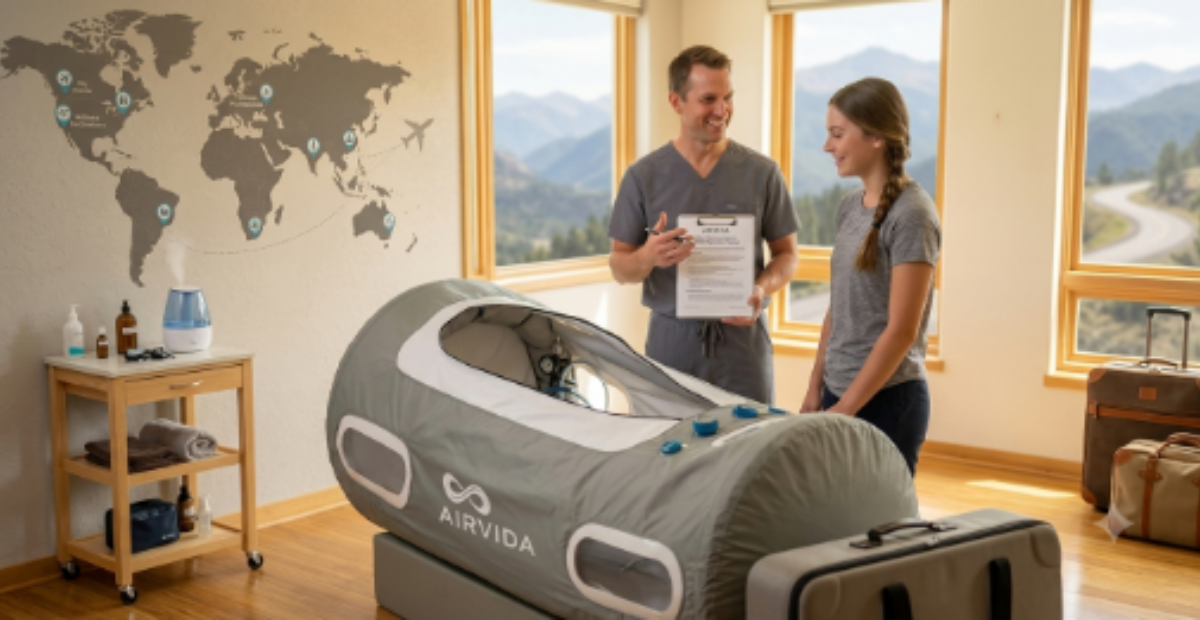
The best hyperbaric chamber for travelers is a lightweight, foldable soft-shell (mild) chamber that operates around 1.3 ATA, packs into a rolling case or two carry-able bags, and sets up in under 15 minutes without a permanent room. If you cross time zones often, spend nights at altitude, or train on the road, a portable soft-shell unit gives you consistent recovery access without renting clinic time in an unfamiliar city.
Below is exactly what "travel-friendly" means in this category, what to check before you buy, and the real limits worth knowing before you fly with one.
Key Takeaways
-
Soft-shell chambers win for travel. They fold, weigh far less than hard-shell units, and set up anywhere with a standard outlet.
-
Pressure matters more than size. Most portable travel chambers run ~1.3 ATA (mild HBOT); higher pressures require heavier hard-shell builds.
-
"Portable" is not "carry-on." Even light units run 80–150 lbs packed; plan for checked freight or a home-base setup, not airplane overhead bins.
-
Timing around flights is real. Ear-pressure and gas-equalization factors mean you should not treat and fly back-to-back without care.
-
Match the chamber to your travel style: altitude trips, long-haul recovery, and family road trips each favor different specs.
What Is the Best Hyperbaric Chamber for Travelers?

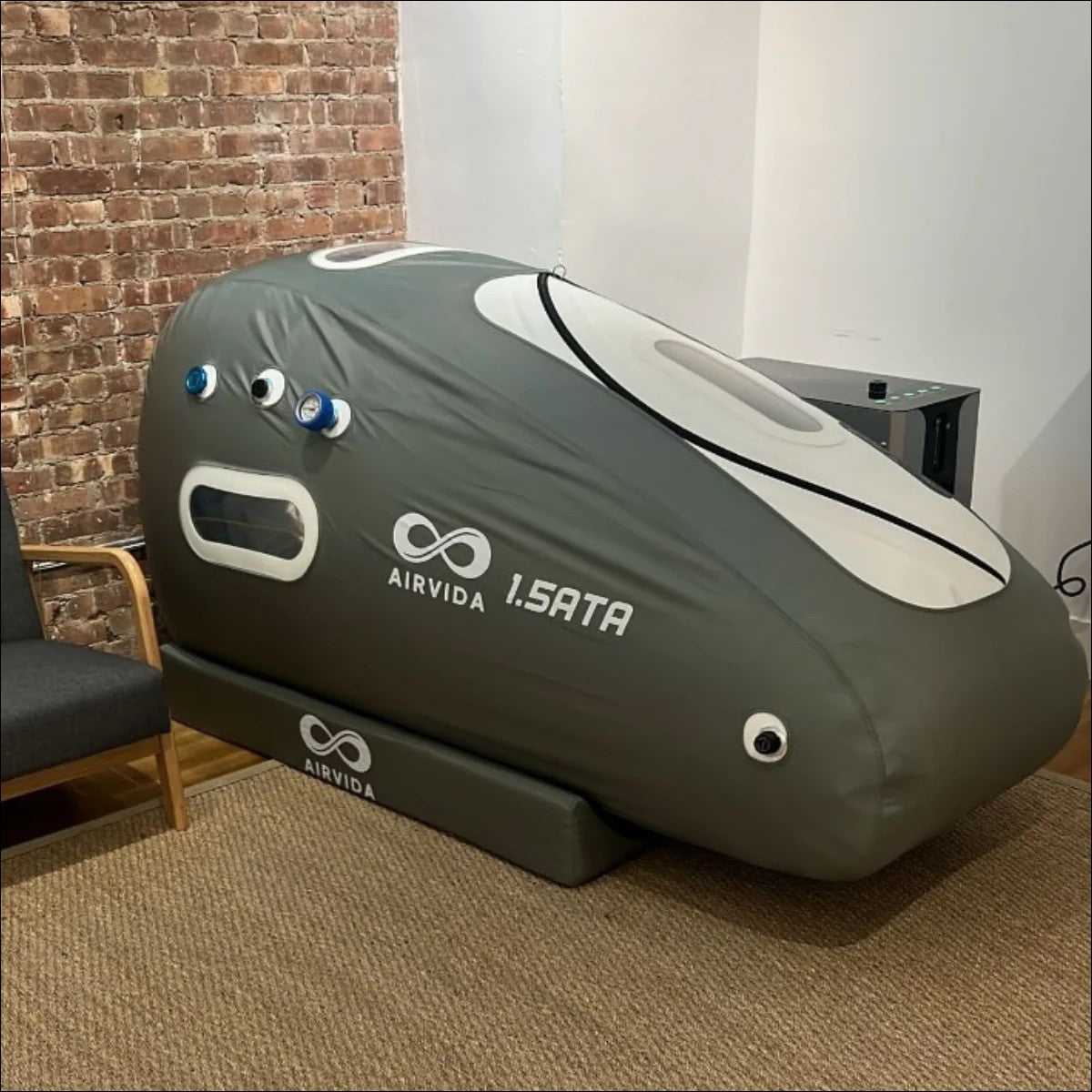
A hyperbaric chamber is a sealed enclosure that raises the air pressure around you above sea level, letting your lungs take in more oxygen per breath. For travelers, the practical version is a portable soft-shell chamber: an inflatable, TPU-or-nylon cylinder pressurized by an external air compressor, typically to about 1.3 atmospheres absolute (ATA). That's the "mild hyperbaric" tier, sometimes written as mHBOT.
The best travel chamber isn't the one with the biggest specs. It's the one you'll actually keep using when you're jet-lagged in a hotel or based out of a rental for a month. That means three things matter most: packed weight, setup speed, and a compressor that runs on standard power.
If you're comparing a portable unit against a stationary clinic model, browse a curated range of soft-shell hyperbaric chambers first; that category is where nearly every genuinely travel-viable option lives.
Hyperbaric Collections You May Want to Shop

Why Portable Hyperbaric Access Matters Right Now
Recovery-focused travel has moved from niche to mainstream. Athletes carry their own protocols on the road, remote workers spend weeks at a stretch away from home, and mountain-town trips routinely push visitors above 8,000 feet where the air thins fast.
The catch: clinic access disappears the moment you leave home. Finding a walk-in hyperbaric session in an unfamiliar city is slow, expensive, and often impossible on short notice. Owning a portable chamber flips that: your recovery tool travels with your itinerary instead of being tied to one address.
There's also the altitude angle, which is the one travel use case with the strongest physiological logic. Portable hyperbaric bags have been used in mountaineering for decades to temporarily simulate a lower elevation, and that principle carries over to consumer travel chambers used at high-altitude destinations.
How to Choose a Travel Hyperbaric Chamber

Here's the framework I use when someone asks what to buy for the road.
1. Weight and Pack-Down Format
This is the deciding factor for actual travel. A stationary hard-shell chamber can weigh 400–800+ lbs and is effectively furniture. A portable soft-shell breaks into a folded chamber plus a compressor, usually landing in the 80–150 lb range packed.
-
Best for flying/freight: two-piece soft-shell units that fold into wheeled cases.
-
Best for road trips and RVs: any soft-shell that fits a trunk or cargo area.
-
Not travel-viable: hard-shell units, which belong in a fixed home or clinic setup.
Set expectations early: nothing in this category is carry-on luggage. "Travel chamber" means "reasonable to move between home bases," not "fits under the seat."
2. Pressure Rating (ATA)
Portable soft-shell chambers top out around 1.3 ATA. If you want higher pressures, you're looking at hard-shell hyperbaric chambers, which are heavier, pricier, and not designed to be packed up between cities.
For most travelers' goals general recovery routines, altitude comfort, long-haul reset mild 1.3 ATA soft-shell units are the standard, and they're what the "travel chamber" search is really about.
3. Compressor and Power Requirements
Confirm the compressor runs on a standard 110–120V outlet (or the correct spec for your destination). International travelers should check voltage compatibility and whether the unit needs a step-up/step-down transformer a detail that sinks more overseas setups than any other.
Also check the oxygen concentrator situation, since many mild chambers pair with a concentrator to raise inhaled oxygen. That's a second box to transport, so factor it into your total travel footprint.
4. Setup Time and Solo Usability
A good travel chamber inflates and seals in 10–15 minutes and can be entered and exited without a helper. If a unit needs two people or 45 minutes of assembly, it won't survive real travel use; you'll leave it packed.
5. Capacity
Solo travelers do fine with a single-person cylinder. Families and couples who want to share a unit on trips should look at wider or seated models; the same considerations covered in this guide to the best hyperbaric chamber for families apply directly to shared travel setups.
Hyperbaric Chambers You May Want to Shop
Explore More


Matching the Chamber to Your Type of Travel
Not every traveler needs the same thing. Three common profiles:
The altitude traveler. If your trips involve ski towns, high-desert cities, or trekking above 8,000 feet, prioritize a chamber that's fast to set up in a rental or lodge. This is the use case with the clearest rationale, since added pressure temporarily counteracts the thin-air environment.
The long-haul recovery traveler. Frequent international or cross-country flyers often use a chamber as part of a post-flight reset routine. Evidence here is limited and largely anecdotal, so treat it as a comfort-and-routine tool rather than a guaranteed jet-lag cure.
The family road-tripper. Households driving to a second home or extended stay want a shareable, trunk-friendly unit. Weight and durability outrank premium pressure specs here.
A related profile worth flagging: recovery-focused travelers in specific life stages, such as the considerations in this postpartum hyperbaric chamber guide, which overlap heavily with what makes a chamber comfortable to use away from home.
Common Mistakes and Misconceptions

Buyers repeat the same handful of errors. Avoid these:
-
Assuming it's carry-on portable. No consumer hyperbaric chamber flies in the cabin. Plan for checked freight, shipping ahead, or leaving it at a fixed base.
-
Chasing maximum ATA for travel. Higher pressure means a hard-shell unit that isn't packable. For travel, 1.3 ATA soft-shell is the right tool, not a compromise.
-
Ignoring destination power specs. A compressor wired for U.S. outlets can be useless or unsafe abroad without the correct converter.
-
Treating and boarding a flight immediately. Pressure changes stack. Give your ears and body a buffer between a session and a flight.
-
Believing marketing overreach. Mild hyperbaric therapy is not a proven cure for most conditions it's advertised against. Use accurate expectations and consult a clinician for any medical use.
Step-by-Step: Traveling With a Portable Chamber
A simple sequence that keeps trips smooth:
-
Weigh and measure the packed unit before you commit to a transport method. Confirm airline freight limits or trunk space.
-
Check destination voltage and pack the correct transformer or confirm the unit is dual-voltage.
-
Ship ahead when possible. For long stays, freighting the chamber to your destination beats hauling it through terminals.
-
Set up on a flat, clean surface with clearance around the zipper/seal and near a dedicated outlet.
-
Equalize your ears deliberately during pressurization: swallow, yawn, or use the Valsalva technique as pressure rises to avoid discomfort.
-
Build in a flight buffer. Don't run a session and head straight to the airport; leave time between the two.
Travelers passing through the Bay Area who'd rather try a supervised session before buying can compare local options in Oakland or nearby Santa Clara to test the experience first.
A Quick Safety and Expectations Note

Mild hyperbaric therapy is generally well tolerated, but it isn't right for everyone, and it isn't a substitute for medical care. If you have a lung condition, recent ear or sinus issues, are pregnant, or take certain medications, talk to a qualified clinician before using any chamber. Nothing here is medical advice, and personal results vary widely.
FAQ
Can you do a hyperbaric chamber before flying?
It's generally best to leave a buffer rather than treat and board back-to-back. Both a hyperbaric session and a flight involve pressure changes your ears and sinuses have to equalize, so stacking them without a gap can cause discomfort, and there are gas-related considerations worth respecting. If you plan to use a chamber near a flight, ask your provider or clinician how much time to allow, and never fly with active ear or sinus congestion.
Who should not go into a hyperbaric chamber?
Anyone with an untreated pneumothorax (collapsed lung) should not enter a hyperbaric chamber; that's the main absolute contraindication. Caution also applies to people with certain lung diseases, recent ear or sinus surgery, active respiratory infections or fever, uncontrolled claustrophobia, and some specific medications (for example, certain chemotherapy drugs). Pregnancy warrants a clinician's sign-off. When in doubt, get individualized medical clearance before your first session.
Does HBOT increase white blood cells?
Hyperbaric oxygen therapy is better understood as enhancing how white blood cells function than as reliably raising their count. Higher tissue oxygen levels can improve the oxygen-dependent, bacteria-killing activity of neutrophils, which is one reason HBOT is used clinically for certain infections. Claims that it dramatically boosts your white-cell numbers overstate the evidence, so treat those with skepticism.
Can a hyperbaric chamber help with altitude sickness?
Yes, this is one of the most established travel uses. Portable hyperbaric bags have long been used in mountaineering to temporarily simulate a lower elevation, relieving symptoms of acute altitude sickness by restoring more normal oxygen conditions. It's a bridging measure, not a cure: the definitive treatment for serious altitude illness is descent and medical care, and a chamber is a tool to buy time and comfort, not a reason to keep climbing.
The Bottom Line
The best hyperbaric chamber for travelers is a portable soft-shell unit at roughly 1.3 ATA that you can pack, power, and set up wherever your itinerary lands, with altitude trips and shared family travel each nudging you toward slightly different specs. Get the weight, pressure, and power details right, respect the flight-timing rules, and keep your expectations grounded in evidence.
Ready to find a travel-friendly setup? Explore the soft-shell hyperbaric chamber collection to compare packable models, or book a trial session in Oakland or Santa Clara to feel the difference before you commit.