


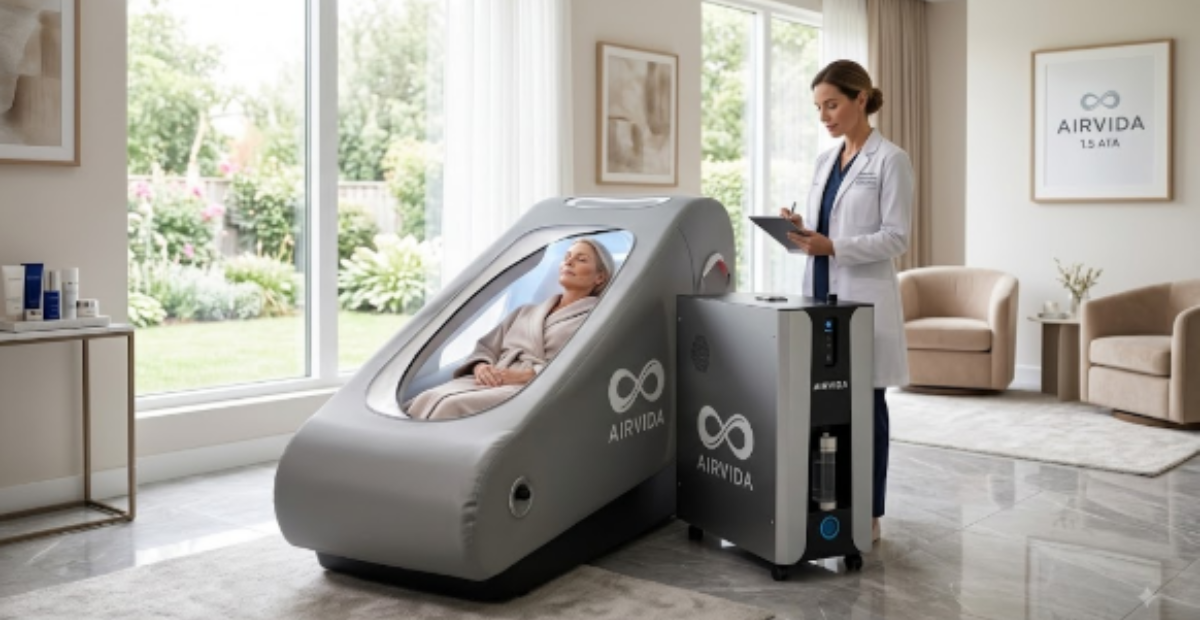
Hyperbaric oxygen therapy (HBOT) supports facelift recovery by delivering high-concentration oxygen to healing tissues under increased atmospheric pressure, which research links to reduced bruising, lower infection rates, and faster tissue repair. A peer-reviewed case-control study published in the Aesthetic Surgery Journal Open Forum (2023) found that patients who received HBOT after facelift surgery experienced measurably better outcomes compared to those who did not. Separately, emerging clinical evidence suggests HBOT may also target biological markers of skin aging independent of surgery.
Key Takeaways
-
HBOT reduces post-facelift bruising by 35% at one week post-operation, according to a peer-reviewed study published in Archives of Facial Plastic Surgery by Dr. Andrew Jacono and Dr. Benjamin Stong.
-
The average facelift patient receives 7.22 HBOT sessions, with sessions ranging from 60 to 90 minutes each, beginning within 24 hours of surgery, based on a 2023 Aesthetic Surgery Journal Open Forum case-control study.
-
HBOT has been associated with lower rates of post-operative pain and infection in patients recovering from facelift surgery.
-
Hyperbaric oxygen stimulates angiogenesis and clears senescent cells, two key mechanisms in skin aging, according to a 2021 prospective clinical trial published in the journal Aging.
-
A 2024 evidence-based review in the Journal of Cosmetic Dermatology confirms that clinical centers are increasingly offering HBOT as an adjunctive therapy for skin rejuvenation.
-
Research on cosmetic HBOT remains an area of ongoing investigation, and comprehensive clinical studies are still needed to establish standardized protocols.
What Is Hyperbaric Oxygen Therapy and How Does It Work for Facelift Recovery?
Hyperbaric oxygen therapy is a medical treatment in which you breathe concentrated oxygen inside a pressurized chamber, allowing your blood plasma to carry significantly more oxygen than under normal atmospheric conditions. This oxygen-rich environment accelerates cellular repair, reduces inflammation, and promotes the growth of new blood vessels in damaged tissue. For facelift patients, these effects directly target the physiological stressors that slow recovery: poor local circulation, tissue trauma, and swelling.
During a facelift, surgical dissection disrupts blood supply to facial tissues. Oxygen delivery to those tissues drops sharply in the days immediately following the procedure. HBOT counteracts this deficit by saturating plasma with oxygen, reaching areas where red blood cells cannot easily travel due to swelling or disrupted capillaries.
The pressurized environment also creates conditions that support collagen synthesis, which is central to both wound healing and long-term skin quality. The bottom line is that HBOT addresses the biological bottlenecks of surgical recovery at the cellular level.
What Does the Research Say About HBOT and Facelift Outcomes?

Clinical evidence supporting HBOT for facelift recovery is among the strongest available for any cosmetic surgical adjunct, with peer-reviewed data from both randomized-style and case-control designs. A study published in Archives of Facial Plastic Surgery (September-October 2010) by Dr. Andrew Jacono and Dr. Benjamin Stong found a 35% reduction in bruising at one week post-operation among facelift patients who received perioperative HBOT. This remains one of the most cited figures in this area of plastic surgery research.
A more recent 2023 case-control study published in the Aesthetic Surgery Journal Open Forum compared facelift outcomes in patients who received HBOT between 2019 and 2022 versus those who did not. The study, also indexed on PubMed Central, found HBOT to be a promising adjunctive therapy for patients undergoing facelift surgery. Patients who received HBOT also demonstrated lower rates of pain and infection post-operatively.
A 2024 evidence-based review in the Journal of Cosmetic Dermatology noted that many clinical centers are now actively promoting HBOT for both post-surgical recovery and skin rejuvenation purposes. However, the review also acknowledged that comprehensive, large-scale clinical trials are still needed to establish definitive protocols. The key point is that existing peer-reviewed data supports HBOT as an adjunct to facelift surgery, not a replacement for it.
Hyperbaric Collections You May Want to Shop

How Does HBOT Compare to Standard Post-Facelift Recovery Protocols?
Standard post-facelift recovery typically involves rest, compression garments, cold compresses, and prescription anti-inflammatories, while HBOT adds a biologically active layer of oxygen-driven tissue repair that these passive methods cannot replicate.
Here is a direct comparison of standard recovery versus HBOT-assisted recovery:
|
Recovery Factor |
Standard Protocol |
HBOT-Assisted Protocol |
|
Bruising reduction speed |
Gradual over 2-3 weeks |
Up to 35% reduction by day 7 (Jacono, 2010) |
|
Tissue oxygenation |
Dependent on intact circulation |
Directly augmented via pressurized oxygen delivery |
|
Infection risk |
Standard surgical risk |
Associated with lower post-op infection rates (2023 study) |
|
Pain management |
Medication-based |
Lower pain rates noted in HBOT cohort (2023 study) |
|
Collagen synthesis support |
Passive healing |
Actively stimulated by hyperoxic environment |
|
Session requirement |
N/A |
Average 7.22 sessions, 60-90 min each (2023 study) |
|
Cost |
Covered by most recovery protocols |
Typically $150-$300 per session, usually out-of-pocket |
The 2023 case-control study noted that the first HBOT session was initiated within 24 hours of surgery, with each session lasting an average of 78 minutes (plus or minus 5 minutes). The bottom line is that HBOT adds measurable clinical benefit when layered onto, not substituted for, a standard post-operative recovery plan.
Can HBOT Support Skin Rejuvenation Without Surgery?

HBOT may offer standalone anti-aging benefits by targeting the biological mechanisms of skin aging, including telomere shortening, accumulation of senescent cells, and reduced angiogenesis. A 2021 prospective clinical trial published in the journal Aging showed, for the first time in humans, that HBOT can significantly modulate the pathophysiology of skin aging in a healthy aging population through angiogenesis and senescent cell clearance.
A 2014 review from the Department of Physiology at Loma Linda University School of Medicine, published via NIH, found that oxygen plays an important role in skin rejuvenation, treatment of photoaging, and improvement in skin complexion. The review identified that HBOT and hyperoxic conditions may attenuate wrinkle formation from UV irradiation by possibly inhibiting pathways including HIF1-alpha, VEGF, neutrophil infiltrations, and MMP-2 and MMP-9. These are well-established molecular pathways in photoaging and inflammation research.
It is important to note that non-surgical cosmetic HBOT remains an area of ongoing investigation. The 2024 Journal of Cosmetic Dermatology review emphasizes that efficacy for skin rejuvenation can only be firmly established through rigorous clinical evaluations with objective outcome measures. The key point is that early biological evidence is promising, but non-surgical cosmetic HBOT should be approached as a complementary wellness option while the research base continues to develop.
What Is the Step-by-Step HBOT Protocol for Facelift Recovery?
A structured HBOT protocol for facelift recovery begins within 24 hours of surgery and continues over approximately one to two weeks, based on the session parameters documented in the 2023 Aesthetic Surgery Journal Open Forum study. Here is a clinically grounded overview of how the protocol typically unfolds:
-
Initiate HBOT within 24 hours post-surgery. Early oxygen delivery targets the acute inflammatory phase when tissue hypoxia is most pronounced.
-
Schedule sessions lasting 60 to 90 minutes each. The 2023 study documented an average session length of 78 minutes (plus or minus 5 minutes).
-
Complete an average of 7 sessions total. The study recorded an average of 7.22 sessions per patient, with a range of 1 to 15 depending on individual clinical presentation.
-
Combine with your surgeon's standard post-op instructions. HBOT does not replace wound care, compression, activity restrictions, or prescribed medications.
-
Monitor bruising and swelling progress after each session. The 35% reduction in bruising documented by Jacono and Stong was measured at the one-week mark, giving you a useful early benchmark.
-
Discuss session frequency with your treating physician. Optimal scheduling can vary based on individual healing rate, tissue condition, and surgical complexity.
-
Complete the full recommended course before assessing results. Partial courses may not deliver the full benefit seen in clinical studies.
The bottom line is that early initiation and consistent session completion are the two factors most clearly associated with improved outcomes in the existing research.
Are There Risks or Contraindications to HBOT for Facelift Patients?
HBOT is generally well-tolerated, but several medical conditions and situations make it contraindicated or require physician evaluation before use. You should not undergo HBOT if you have untreated pneumothorax (collapsed lung), as pressurization can worsen this condition. Additional situations that require careful physician review include:
-
Certain pulmonary conditions, including severe chronic obstructive pulmonary disease
-
Active ear or sinus infections that may worsen under pressure changes
-
Certain medications that interact with high-oxygen environments (to be assessed by your physician)
-
Claustrophobia, which may affect tolerance of enclosed chamber sessions
-
Recent thoracic surgery, depending on the type and healing stage
A 2021 NIH-indexed review on vascular complications with injection implants and a separate 2024 NIH case report on filler-induced blindness treatment both illustrate how HBOT is being applied in emergency aesthetic complications, where its oxygen-delivery properties help salvage compromised tissue. These applications confirm the therapy's active physiological effects and underscore why proper medical supervision is non-negotiable.
The key point is that HBOT carries a favorable safety profile for most healthy post-surgical adults, but you should always disclose your full medical history to both your surgeon and the HBOT provider before beginning treatment.
Hyperbaric Chambers You May Want to Shop
Explore More


How Do You Find Quality HBOT Services for Facelift Recovery in the Bay Area?
Accessing professional-grade hyperbaric oxygen therapy in Northern California requires selecting a facility with medical oversight and properly maintained equipment. If you are based in or near the San Francisco Bay Area, several regional options exist for post-surgical or wellness-focused HBOT. You can explore hyperbaric chamber services in Oakland, Santa Clara, San Mateo, and Mountain View depending on your location and proximity to your surgical provider.
For physical therapy clinics and healthcare professionals evaluating chamber options, the best hyperbaric chamber for physical therapy clinics guide provides a structured comparison of equipment types and clinical considerations. Choosing a provider close to your surgeon's office is practical during the post-operative period, especially when sessions are scheduled daily or every other day in the first week.
The bottom line is that geographic convenience, medical supervision, and equipment quality are the three primary factors to evaluate when selecting an HBOT provider for facelift recovery.
Should You Use a Hyperbaric Chamber Before or After Your Facelift?
The clinical research on HBOT for facelift outcomes focuses primarily on post-operative use, with the 2023 case-control study explicitly noting that sessions were initiated within 24 hours after surgery. There is currently less peer-reviewed data on pre-operative HBOT as a preparation strategy for facelift patients specifically. Some practitioners theorize that pre-conditioning tissues with oxygen before surgery may improve baseline healing capacity, but this remains an area of ongoing investigation.
Post-operative use is where the evidence is clearest and where you are most likely to see the documented benefits: reduced bruising, lower pain scores, and a possible reduction in infection risk. If you are considering HBOT as part of a broader skin rejuvenation routine without planned surgery, the emerging evidence on senescent cell clearance and angiogenesis is encouraging but should be discussed with a physician who can contextualize it against your individual skin health goals.
The bottom line is that post-operative HBOT, initiated within 24 hours of surgery, is where the peer-reviewed evidence is strongest, and that is where you should focus your planning conversations with your surgical team.
Conclusion: Is a Hyperbaric Chamber Worth It for Facelift Recovery?
The peer-reviewed evidence supporting HBOT as an adjunct to facelift surgery is clinically meaningful. A 35% reduction in bruising at one week, lower post-operative pain, and reduced infection rates are outcomes that directly affect patient comfort, recovery speed, and satisfaction. The biological mechanisms, including oxygen-driven angiogenesis, collagen synthesis stimulation, and senescent cell clearance, are well-documented in the scientific literature and provide a coherent framework for why these clinical improvements occur.
Whether you are preparing for a facelift, recovering from one, or exploring non-surgical skin rejuvenation, HBOT represents a scientifically grounded option that warrants a direct conversation with your plastic surgeon and a qualified hyperbaric provider.
The bottom line: Hyperbaric oxygen therapy is a peer-reviewed, clinically studied adjunct to facelift surgery that reduces bruising, supports tissue healing, and may improve overall recovery outcomes, making it one of the most evidence-supported post-operative tools currently available to facelift patients.
Frequently Asked Questions
Can a hyperbaric chamber make you look younger?
A hyperbaric chamber may support a younger-looking appearance by stimulating angiogenesis and clearing senescent cells, two biological markers of skin aging, according to a 2021 prospective clinical trial published in the journal Aging on NIH. The same research base shows that hyperoxic conditions may reduce photoaging-related wrinkle formation by inhibiting inflammatory pathways including MMP-2 and MMP-9. These effects are biologically plausible but should be discussed with a physician before pursuing HBOT specifically for cosmetic rejuvenation.
When should you not use a hyperbaric chamber?
You should not use a hyperbaric chamber if you have an untreated collapsed lung (pneumothorax), as pressurization can worsen this condition. Additional contraindications requiring physician evaluation include certain pulmonary diseases, active ear or sinus infections, specific medication interactions, and recent thoracic surgery. Always disclose your full medical history to both your treating physician and the HBOT facility before beginning sessions.
How many HBOT sessions for anti-aging?
For post-facelift recovery, a 2023 peer-reviewed case-control study in the Aesthetic Surgery Journal Open Forum documented an average of 7.22 sessions per patient, ranging from 1 to 15, with sessions lasting 60 to 90 minutes each. For non-surgical anti-aging purposes, no universally standardized protocol has been established in the peer-reviewed literature as of 2026. You should consult with a physician to determine a session count appropriate for your specific health status and goals.
How to speed up healing after a facelift?
You can speed up healing after a facelift by following your surgeon's post-operative instructions closely, including rest, compression, and wound care, while considering HBOT as an evidence-supported adjunct. Research shows that initiating HBOT within 24 hours of surgery and completing an average of 7 sessions significantly reduces bruising and may lower infection and pain rates. Staying well-hydrated, avoiding smoking, and minimizing sun exposure to the healing area are additional physician-recommended strategies.
Does HBOT help recovery of facelift?
Yes, HBOT helps facelift recovery according to peer-reviewed clinical evidence. A 2023 case-control study published in the Aesthetic Surgery Journal Open Forum found that facelift patients who received HBOT experienced better outcomes than those who did not, with associated reductions in bruising, pain, and infection rates. A separate earlier study documented a 35% reduction in bruising at one week post-operation in HBOT-treated facelift patients.