


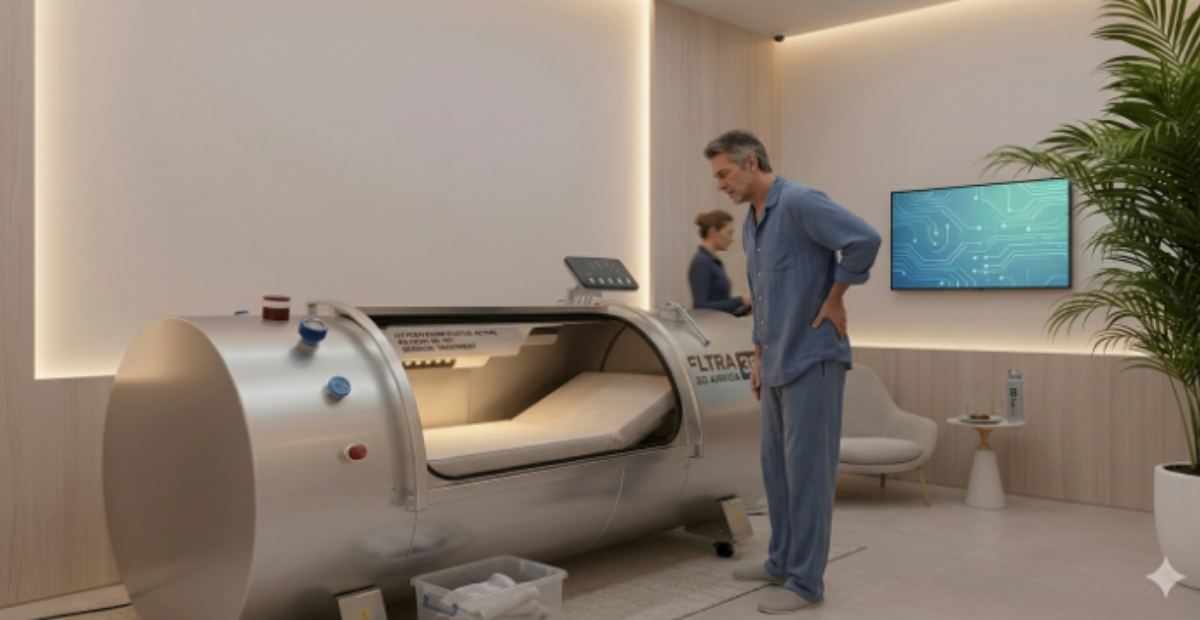
A hyperbaric chamber delivers 100% oxygen at pressures greater than normal sea level atmosphere, and clinical research suggests it may reduce pain intensity, improve functioning, and decrease inflammatory markers in selected chronic pain conditions. Evidence is strongest for fibromyalgia and complex regional pain syndrome (CRPS), where multiple trials and systematic reviews report meaningful within-group improvements. HBOT is currently considered a potential adjunctive intervention, not a standalone cure, and ongoing research continues to define optimal protocols and patient selection.
Key Takeaways
-
Hyperbaric oxygen therapy (HBOT) is an adjunctive treatment that delivers 100% oxygen at elevated atmospheric pressure to increase tissue oxygenation and modulate pain signaling.
-
A 2025 systematic review of 11 RCTs found consistent pain reductions in fibromyalgia, with additional evidence supporting use in CRPS and neuropathic pain conditions.
-
In CRPS studies, 86% to 97% of patients reported symptomatic improvement following HBOT across various pain subtypes.
-
Typical treatment protocols involve 20 to 60 sessions, each lasting 60 to 90 minutes at 1.3 to 2.5 atmospheres absolute (ATA).
-
HBOT is generally well tolerated, with mostly mild adverse events reported across reviewed trials and no serious injuries documented in major systematic reviews.
-
Patients with shorter pain duration respond better to HBOT, with one study finding significantly higher response rates in those treated within the first three to six months of symptom onset.
What Is Hyperbaric Oxygen Therapy and How Does It Work for Chronic Pain?
Hyperbaric oxygen therapy (HBOT) is a treatment modality that involves breathing 100% oxygen inside a pressurized chamber at levels greater than standard atmospheric pressure, typically ranging from 1.3 to 2.5 ATA. This elevated pressure allows oxygen to dissolve more efficiently into blood plasma, reaching tissues that may be poorly perfused under normal conditions. Researchers believe this increased oxygen delivery addresses one of the underlying mechanisms of chronic pain: tissue hypoxia, or insufficient oxygen supply to affected areas.
Chronic pain is thought to involve a cycle of local oxygen deficit, redox imbalance, and ongoing inflammatory signaling. HBOT may interrupt this cycle by reducing hypoxia-driven inflammation, modulating pain-sensitizing neuropeptides, and promoting tissue repair. Animal studies have demonstrated that HBOT attenuates neuropathic pain and reverses inflammatory signaling, providing a mechanistic basis for human trials.
A 2021 narrative review published in Pain Research and Management described HBOT as having antinociceptive and analgesic effects in models of inflammatory, neuropathic, and chronic pain. The key point is that while the biological rationale is well-supported, translating animal findings into consistent human outcomes remains an active area of investigation.
What Does the Clinical Evidence Show for Chronic Pain Conditions?

The clinical evidence for HBOT in chronic pain is strongest for fibromyalgia and CRPS, with emerging support for neuropathic pain and musculoskeletal conditions. A 2025 systematic review published on PubMed analyzed 11 randomized controlled trials involving 480 participants. Eight of the 11 studies focused on fibromyalgia, with additional trials examining CRPS, idiopathic trigeminal neuralgia, and radiation-induced brachial neuropathy.
Most trials in this review showed consistent within-group improvements in pain scores, functional capacity, and quality of life. However, the reviewers noted that most trials carried some risk of bias, primarily due to subjective outcome measures and challenges in blinding participants. This means results should be interpreted cautiously, and future high-quality trials are needed to confirm effect sizes.
A separate 2025 systematic review from PMC/NIH examined 18 studies covering 671 participants across musculoskeletal pain syndromes. That review found consistent reductions in pain and modest functional improvements in fibromyalgia and postoperative conditions, including knee arthroplasty recovery and peripheral nerve repair. The bottom line is that the cumulative evidence supports HBOT as a useful adjunctive option in specific chronic pain populations, though larger blinded trials remain necessary.
How Does HBOT Specifically Help Fibromyalgia?
Fibromyalgia is the chronic pain condition with the most robust HBOT evidence, supported by multiple randomized controlled trials and at least one direct comparison with standard pharmacological treatment. A 2024 RCT published in Nature Scientific Reports compared 60 HBOT sessions (100% oxygen at 2.0 ATA for 90 minutes, five days per week over 12 weeks) against standard drug therapy including duloxetine or pregabalin. Outcomes measured included global functioning, pain intensity, psychological status, quality of life, pressure pain threshold, and brain activity via SPECT imaging.
A 2024 meta-analysis provided pooled numerical data across fibromyalgia trials, reporting:
-
Decreased tender points: -6.23 (95% CI: -7.76 to -4.71), P < 0.0001
-
Increased pain threshold: 0.57 (95% CI: 0.30 to 0.83), P < 0.00001
-
Decreased Visual Analog Scale (VAS) pain score: -5.31 (95% CI: -8.17 to -2.45)
These effect sizes are clinically meaningful and suggest HBOT produces measurable, not merely subjective, changes in pain processing. A 2024 study by Izquierdo-Alventosa et al., referenced in PMC, used 40 sessions at 1.45 ATA over 8 weeks and assessed psychological constructs related to pain, pain catastrophizing, and quality of life, finding additional benefits in psychological pain-related outcomes. The key point is that fibromyalgia patients show consistent within-group improvements across multiple trial designs and protocols.
Hyperbaric Collections You May Want to Shop

Can HBOT Help Complex Regional Pain Syndrome (CRPS)?
Complex regional pain syndrome (CRPS) is a chronic pain condition characterized by severe, disproportionate pain, autonomic dysfunction, and sensory abnormalities, and HBOT has shown particularly strong results in this population. A January 2025 review published on PubMed analyzed 13 studies involving 280 participants. Treatment protocols ranged from 3 to 63 sessions, typically delivered at 2.4 ATA for 90 minutes per session.
Response rates reported across CRPS subtypes were notably high:
-
Sympathetically maintained pain: 97% of subjects reported relief
-
Sympathetically independent pain: 94% reported relief
-
Indeterminate subtype: 100% reported relief
A 2024 retrospective study from the Czech Republic, referenced in PMC, analyzed 83 CRPS patients who underwent HBOT at 2.0 to 2.4 ATA, with a mean of 22 sessions. In that study, 86% of patients reported symptomatic improvement. Critically, one study found that patients with a disease duration of less than three to six months showed significantly higher response rates (P = 0.029), suggesting earlier intervention may produce better outcomes. For more context on how HBOT applies to inflammatory joint conditions, reviewing hyperbaric chamber benefits for arthritis provides relevant mechanistic overlap. The bottom line is that CRPS currently represents one of the most evidence-supported applications of HBOT in chronic pain management.
What Types of Chronic Pain Can Hyperbaric Chambers Address?

HBOT has been studied across several chronic pain categories, with varying levels of evidence for each. Below is a structured overview of pain conditions and the current level of supporting evidence:
|
Pain Condition |
Evidence Level |
Key Finding |
|
Fibromyalgia |
Strongest (8 RCTs) |
Consistent pain and function improvements |
|
Complex Regional Pain Syndrome |
Strong (13 studies, 280 patients) |
86-97% symptomatic improvement reported |
|
Neuropathic Pain (peripheral) |
Moderate |
Supported for radiation-induced plexopathy, postherpetic neuralgia, trigeminal neuralgia |
|
Musculoskeletal Pain |
Moderate (18 studies, 671 patients) |
Pain reduction and functional gains in fibromyalgia and postoperative recovery |
|
Chronic Bladder Pain Syndrome |
Emerging |
Cited as having robust clinical evidence in one 2025 review |
|
Idiopathic Trigeminal Neuralgia |
Limited (1 RCT) |
Included in 2025 systematic review; needs replication |
Neuropathic pain conditions supported by HBOT evidence specifically include radiation-induced plexus neuropathies, postherpetic neuralgia, and trigeminal neuralgia, as documented in a 2021 review in Pain Research and Management by Schiavo et al. Animal model data additionally demonstrate antinociceptive effects across inflammatory and neuropathic pain categories, providing a biological rationale for broader application. The key point is that condition-specific evidence varies significantly, and HBOT is not equally validated across all chronic pain diagnoses.
What Does a Standard HBOT Protocol Look Like for Chronic Pain?
A standard HBOT protocol for chronic pain typically involves multiple sessions delivered over several weeks, with pressure and duration adjusted based on the target condition. The following is a general framework drawn from published trials:
Typical HBOT Protocol for Chronic Pain:
-
Pressure setting: 1.3 to 2.5 ATA, with most chronic pain trials using 1.45 to 2.4 ATA
-
Session duration: 60 to 90 minutes per session
-
Session frequency: Typically five days per week
-
Total sessions: Ranges from 20 to 60 sessions depending on condition and response
-
Oxygen concentration: 100% oxygen delivered throughout the session
-
Monitoring: Vital signs and symptom tracking between sessions
Fibromyalgia trials have commonly used 40 to 60 sessions at 1.45 to 2.0 ATA, while CRPS protocols have ranged more widely from 3 to 63 sessions at up to 2.4 ATA. The variability in protocols across studies is one reason that standardized treatment guidelines remain an active area of research and discussion. The bottom line is that you should work with a qualified clinician to determine the protocol most appropriate for your specific condition and baseline health status.
Hyperbaric Chambers You May Want to Shop
Explore More


How Does HBOT Compare to Other Chronic Pain Treatments?
HBOT is distinct from conventional chronic pain treatments in its mechanism, delivery format, and evidence profile. Standard treatment options for chronic pain include pharmacological management (analgesics, anticonvulsants, antidepressants), physical therapy, interventional procedures, and psychological approaches such as cognitive behavioral therapy. HBOT does not replace these options but may function as an effective adjunctive modality.
In the 2024 fibromyalgia RCT published in Nature, HBOT was directly compared to duloxetine or pregabalin. Results indicated HBOT produced comparable or superior improvements in specific outcome domains, including pressure pain threshold and quality of life measures. This is a significant finding given that pharmacological options for fibromyalgia carry their own tolerability limitations, including weight gain, cognitive side effects, and dependency risk.
Complementary approaches such as full body red light therapy are also being explored as adjunctive pain management tools, and some practices offer both modalities. The key point is that HBOT should be viewed as part of a multimodal chronic pain management strategy rather than a replacement for established treatments.
Is Hyperbaric Oxygen Therapy Safe for Chronic Pain Patients?
HBOT has a favorable safety profile in chronic pain populations, with published systematic reviews consistently reporting mostly mild adverse events and no serious injuries. The 2025 systematic review of musculoskeletal pain syndromes found that HBOT was generally well tolerated, with no serious HBOT-related complications or injuries documented across 18 included studies. The most commonly reported mild adverse events in the broader HBOT literature include ear pressure discomfort (barotrauma to the ear), temporary visual changes, and transient fatigue.
Certain populations require additional caution or exclusion before initiating HBOT. Contraindications and precautionary groups include:
-
People with untreated pneumothorax (collapsed lung)
-
Individuals taking certain medications (for example, doxorubicin or cisplatin) that may interact with high-dose oxygen
-
Those with claustrophobia that cannot be managed in an enclosed chamber
-
Patients with uncontrolled seizure disorders
-
Individuals with certain types of lung disease where oxygen retention is a concern
The bottom line is that while HBOT carries a strong safety record in reviewed chronic pain trials, individual medical evaluation is necessary before starting treatment to identify any contraindications specific to your health history.
What Is the Bottom Line on Hyperbaric Chambers for Chronic Pain?

The evidence base for HBOT in chronic pain management has grown meaningfully in recent years, with systematic reviews, meta-analyses, and randomized controlled trials collectively suggesting benefit across fibromyalgia, CRPS, and neuropathic pain conditions. Effect sizes in fibromyalgia are statistically significant and clinically meaningful, and CRPS response rates across subtypes are notably high in observational and clinical data.
HBOT remains best understood as an adjunctive therapy, most effective when integrated into a broader chronic pain management plan. Patient selection, timing of intervention, and adherence to a structured multi-session protocol each appear to influence outcomes. Research institutions continue to investigate optimal pressure settings, session counts, and combinations with other therapies such as clinical-grade red light therapy for synergistic benefit.
The bottom line: hyperbaric oxygen therapy shows clinically meaningful potential as an adjunctive treatment for chronic pain, with the strongest evidence in fibromyalgia and CRPS, and a favorable safety profile across reviewed trials.
Frequently Asked Questions
What are the potential side effects of using a hyperbaric chamber?
The most common side effects of hyperbaric chambers are mild and include ear pressure discomfort or barotrauma, temporary blurred vision, sinus pressure, and transient fatigue following sessions. Serious adverse events are rare; published systematic reviews of chronic pain trials report no serious HBOT-related complications or injuries. People with claustrophobia may find the enclosed environment challenging.
What are the treatment options for chronic pain?
Chronic pain treatment options include pharmacological management (analgesics, anticonvulsants, antidepressants such as duloxetine or pregabalin), physical therapy, interventional procedures (nerve blocks, injections), cognitive behavioral therapy, and adjunctive modalities such as HBOT and red light therapy. A multimodal approach combining several strategies typically produces better outcomes than any single treatment alone. Your clinician can help design a plan based on your specific pain condition and health history.
How long do the effects of hyperbaric oxygen therapy last?
The duration of HBOT's effects on chronic pain is not yet precisely established and remains an area of ongoing investigation. Clinical trials document outcomes at the end of treatment courses and at follow-up intervals, with some studies showing sustained improvements in pain scores and quality of life at post-treatment follow-up periods. Longer and more durable effects may require maintenance sessions or integration with other ongoing treatments.
Why does blood sugar drop in a hyperbaric chamber?
Blood sugar can drop during hyperbaric oxygen sessions because elevated oxygen levels at increased atmospheric pressure enhance glucose metabolism and increase insulin sensitivity in tissues. This metabolic effect means the body processes glucose more efficiently during HBOT, which can lower circulating blood glucose. People with diabetes or conditions affecting blood sugar regulation should be monitored closely before and after sessions and may need to adjust food intake or medications accordingly.
Who should avoid hyperbaric chambers?
People who should avoid hyperbaric chambers include those with untreated pneumothorax, certain lung diseases where oxygen handling is compromised, uncontrolled seizure disorders, and those taking specific medications that interact negatively with high-pressure oxygen. Individuals with severe, unmanaged claustrophobia may also be unable to complete treatment comfortably. A thorough medical evaluation by a qualified clinician is essential before starting any HBOT protocol.