


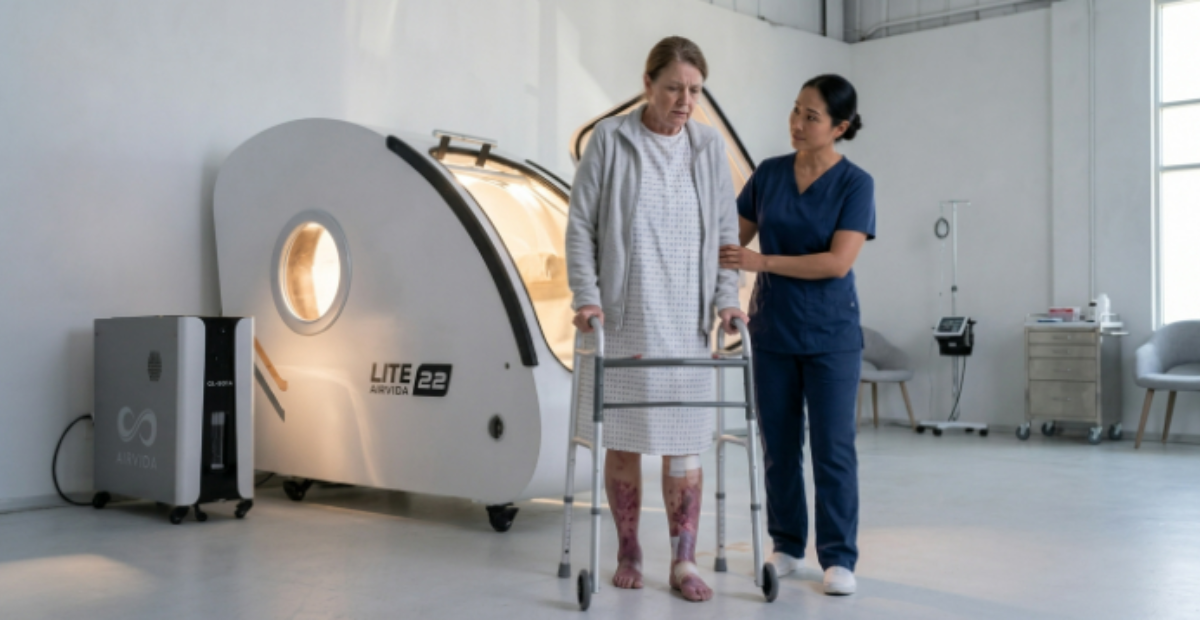
Hyperbaric oxygen therapy (HBOT) is an adjunctive treatment for calciphylaxis that delivers 100% oxygen at increased atmospheric pressure to improve tissue oxygenation in ischemic, calcium-damaged wounds. Clinical case series and retrospective reviews consistently report wound improvement or complete healing in a substantial portion of patients who complete a full course of treatment. Current medical consensus supports offering HBOT alongside standard therapies, particularly when open wounds are present.
Key Takeaways
-
Calciphylaxis carries a mortality rate exceeding 50% within one year of diagnosis, making aggressive, multidisciplinary treatment essential.
-
HBOT is recommended as an adjunctive intervention for calciphylaxis patients with open wounds, based on multiple case series and retrospective analyses.
-
In one narrative review of 131 patients, 45% achieved complete wound closure with HBOT, and an additional 13% showed substantial partial improvement.
-
A therapeutic minimum of approximately 20 HBOT sessions appears important: patients receiving fewer than 20 treatments in one study showed no measurable clinical improvement.
-
Standard calciphylaxis management combines sodium thiosulfate, bisphosphonates, dialysis optimization, and wound care alongside HBOT rather than relying on any single intervention.
-
HBOT for calciphylaxis remains an area of ongoing investigation, with larger prospective trials still needed to establish uniform treatment protocols.
What Is Calciphylaxis and Why Is It So Dangerous?
Calciphylaxis, also called calcific uraemic arteriolopathy (CUA), is a rare, life-threatening vascular disorder characterized by calcium deposits in small blood vessel walls that cause progressive skin and soft-tissue ischemia, necrosis, and non-healing wounds. It is most commonly seen in patients with end-stage renal disease (ESRD), though non-uremic cases also occur. The lower extremities are the most frequently affected sites, though involvement can appear on the trunk, thighs, and genitalia.
The prognosis is severe. More than 50% of patients die within one year of diagnosis, primarily from sepsis originating in infected wounds. Pain is typically intense and often refractory to standard analgesics. Early recognition and rapid initiation of a multidisciplinary treatment plan are critical to improving survival odds.
The pathogenesis of calciphylaxis remains an area of ongoing investigation. Risk factors include hyperphosphatemia, hypercalcemia, elevated parathyroid hormone, warfarin use, obesity, and female sex. The condition is not fully understood at the molecular level, which partly explains why no single universally approved therapy exists.
The bottom line is that calciphylaxis is a medical emergency requiring immediate, coordinated care.
How Does a Hyperbaric Chamber Work for Calciphylaxis?

HBOT for calciphylaxis is a treatment approach in which a patient breathes pure oxygen inside a pressurized chamber, raising plasma oxygen levels far above what is achievable under normal atmospheric conditions. This hyperoxic state supports tissue repair in wounds where blood vessel calcification has severely restricted local oxygen delivery. By saturating plasma with dissolved oxygen, HBOT bypasses the compromised microcirculation that calciphylaxis creates.
Several mechanisms are proposed to explain HBOT's benefit in calciphylaxis:
-
Enhanced oxygen delivery to ischemic wound margins
-
Promotion of angiogenesis (new blood vessel formation) in damaged tissue
-
Stimulation of fibroblast activity and collagen synthesis needed for wound healing
-
Antimicrobial effect that reduces the risk of secondary wound infection
-
Reduction of inflammatory mediators in hypoxic tissue
Typical treatment protocols in published case series involved sessions at 2.0 to 2.5 atmospheres absolute (ATA), lasting approximately 90 minutes each, administered daily on weekdays. The foundational 2001 study by Podymow and colleagues, published in Nephrology Dialysis Transplant, used 25 to 35 treatments at 2.5 atmospheres for 90 minutes per session. More recent series report patients receiving a median of 45 treatments in combination with conventional care.
The bottom line is that HBOT works by delivering oxygen directly to oxygen-starved tissues, addressing the core physiological deficit that calciphylaxis creates.
What Does the Clinical Evidence Say About HBOT and Calciphylaxis?
The clinical evidence for HBOT in calciphylaxis consists primarily of case reports, case series, and retrospective reviews rather than large randomized controlled trials, but the consistency of positive findings across multiple institutions is notable. A 2020 narrative review published on PubMed (PMID 32176952) aggregated data from 131 patients treated with HBOT: 45% achieved complete wound closure and an additional 13% demonstrated substantial partial improvement, yielding a combined benefit rate of approximately 58%.
A landmark retrospective analysis published in Nephrology Dialysis Transplant (An et al., 2015, PMID 25707425) identified 46 patients with CUA associated with renal failure. Of the 34 who completed a full HBOT course, 58% showed improvement in wound scores, with more than half of those achieving complete wound healing. Patients who responded survived for an average of more than three years, a meaningful outcome given the condition's typical prognosis.
A 2023 retrospective review from Massachusetts General Hospital, published in the Journal of the American Academy of Dermatology, examined 93 patients newly diagnosed with calciphylaxis between January 2006 and December 2021. The study's authors concluded that HBOT should be offered as an additional intervention, particularly for patients with open wounds, to improve outcomes and support wound healing. A separate case series involving penile calciphylaxis, published in PMC (PMC7426662), further documented successful wound resolution with HBOT in an anatomically challenging presentation.
The bottom line is that while randomized controlled trial data remain limited, multiple independent clinical series consistently support HBOT as a beneficial adjunct in calciphylaxis wound management.
Hyperbaric Collections You May Want to Shop


How Many HBOT Sessions Are Needed and What Predicts a Good Outcome?
The number of HBOT sessions needed for calciphylaxis appears to influence outcomes significantly, with a threshold of approximately 20 treatments emerging as clinically meaningful in available data. A 2016 study (PMC5197060) found that patients who improved were able to tolerate the monoplace chamber environment and received at least 20 HBOT treatments. In contrast, patients who received fewer than 20 sessions showed no measurable clinical improvement in their lesions.
Additional factors associated with better outcomes in published series include:
-
Male sex: Males demonstrated more favorable outcomes in at least one series when they received at least 20 sessions
-
Early initiation: Starting HBOT before extensive necrosis and deep tissue destruction occurs
-
Wound openness: Patients with actively open wounds appear to benefit more than those with purely ischemic, non-ulcerated lesions
-
Tolerance of chamber environment: Patients with claustrophobia or severe cardiopulmonary instability may not complete a full course
More recent prospective data presented at the ERA 2023 Congress reported a median of 45 HBOT treatments alongside comprehensive conventional care including sodium thiosulfate, dialysis optimization, vitamin K2, warfarin withdrawal, and nutritional support. This suggests that real-world clinical practice often extends well beyond the 20-session minimum threshold. Clinicians typically reassess wound progress at regular intervals and continue treatment as long as measurable improvement continues.
The bottom line is that completing at least 20 sessions appears to be a minimum threshold for benefit, with many patients receiving 30 to 45 or more treatments in successful case series.
What Is the Standard Calciphylaxis Treatment Protocol? (With HBOT Comparison Table)
Standard calciphylaxis treatment is a multidimensional approach combining risk factor modification, specific pharmacological agents, wound care, and adjunctive therapies including HBOT. No single treatment is universally effective, and combination strategies are standard across published guidelines.
Calciphylaxis Treatment: Standard Components vs. HBOT's Role
|
Treatment Component |
Mechanism |
HBOT's Complementary Role |
|
Sodium thiosulfate |
Chelates calcium, vasodilatory |
HBOT improves tissue oxygenation that thiosulfate cannot restore alone |
|
Bisphosphonates |
Inhibits vascular calcification |
HBOT supports healing in wounds that persist after calcification slows |
|
Warfarin discontinuation |
Removes calcification promoter |
HBOT may accelerate wound recovery after warfarin is stopped |
|
Dialysis optimization |
Corrects calcium-phosphate imbalance |
HBOT addresses ischemic wound deficit not corrected by dialysis alone |
|
Vitamin K2 |
Inhibits vascular calcification |
Adjunctive; may be combined with HBOT without known interaction |
|
Wound care |
Prevents secondary infection |
HBOT's antimicrobial effect complements topical wound management |
|
Pain management |
Improves quality of life |
HBOT may reduce wound pain as healing progresses |
|
HBOT |
Restores oxygen to ischemic tissue |
Central adjunctive intervention for open-wound presentations |
A 2021 nephrology guideline review (PMC8823914) stated that specific treatment should include sodium thiosulfate, bisphosphonates, or hyperbaric oxygen therapy, and that general management includes discontinuing warfarin, iron salts, and corticosteroids while controlling mineral metabolism and intensifying dialysis. Pain control and secondary infection treatment are also foundational.
The bottom line is that HBOT is one component of a comprehensive treatment strategy, not a standalone cure, and it achieves the best results when combined with standard medical management.
Can Calciphylaxis Wounds Actually Heal With HBOT?
Calciphylaxis wound healing with HBOT is documented across multiple published case series, and complete wound closure has been reported in a meaningful percentage of patients. The 2001 Podymow series in Nephrology Dialysis Transplant reported complete resolution of extensive necrotic skin ulcers in two of five patients treated, with no adverse effects noted during HBOT. The 2015 An et al. series found more than half of patients who completed a full HBOT course achieved complete wound healing.
Healing is not guaranteed, and several factors limit outcomes. Patients with very advanced disease, deep tissue necrosis, or systemic sepsis at the time HBOT is initiated may not achieve full closure. Wound healing in calciphylaxis is also a slow process: complete closure may take months of sustained treatment and wound care rather than weeks. Monitoring using validated wound scoring tools at regular intervals helps clinicians track progress and make decisions about continuing, modifying, or stopping HBOT.
It is important to understand that wound healing and survival are not identical endpoints. Some patients may experience wound improvement and extended survival without complete lesion closure. A 2024 publication in a clinical kidney journal (PMC11378655) addressed individualizing treatment within multidimensional care frameworks that include regenerative medicine strategies, reflecting the evolving nature of this field.
The bottom line is that complete wound healing is achievable for a substantial subset of calciphylaxis patients treated with HBOT, particularly those who begin treatment early and complete a full therapeutic course.
Who Is a Candidate for HBOT in Calciphylaxis, and Who Should Avoid It?

Candidates for HBOT in calciphylaxis are typically patients with confirmed calciphylaxis who have open, non-healing wounds and who are medically stable enough to tolerate repeated pressurized oxygen sessions. The 2023 Massachusetts General Hospital study specifically recommended HBOT for patients with open wounds, distinguishing this group from those with purely ischemic presentations without ulceration.
Patients who may not be suitable for HBOT include those with:
-
Untreated pneumothorax: Pressure changes pose a serious risk of tension pneumothorax
-
Severe claustrophobia: Inability to tolerate the enclosed chamber environment prevents treatment completion
-
Certain implanted devices: Some devices are not pressure-rated for hyperbaric environments
-
Uncontrolled seizure disorders: High oxygen concentrations can lower seizure threshold
-
Active ear or sinus pathology: Middle ear and sinus barotrauma risks increase with pressure changes
-
Severe congestive heart failure: Cardiac stress from oxygen and pressure changes may be prohibitive
-
Pregnancy: Considered a relative contraindication in most clinical settings
Because calciphylaxis patients are often medically complex, with ESRD, diabetes, and cardiovascular comorbidities, a thorough pre-treatment evaluation by a hyperbaric medicine physician is essential before initiating any HBOT program. Patients managing related inflammatory or systemic conditions sometimes explore HBOT in contexts such as chronic Lyme disease or mold toxicity, and cross-specialty familiarity with chamber protocols can inform patient preparation.
The bottom line is that patient selection requires careful medical screening, and HBOT should only be initiated when its benefit-to-risk ratio has been assessed for each individual patient.
Hyperbaric Chambers You May Want to Shop
Explore More


What Are the Risks and Side Effects of Hyperbaric Oxygen Therapy?
The risks of hyperbaric oxygen therapy are generally manageable when treatment is administered in a properly equipped facility under physician supervision, but they are real and require informed consent before treatment. The most common side effects are mild and temporary.
Common side effects include:
-
Middle ear barotrauma: Ear pain or pressure during compression and decompression, the most frequently reported complaint
-
Sinus barotrauma: Pain or pressure in the sinuses, particularly in patients with nasal congestion
-
Temporary myopia: Reversible changes in lens shape causing short-term near-sightedness after extended treatment courses
-
Mild fatigue: Reported by some patients after sessions, typically resolving with rest
Serious but less common risks include:
-
Oxygen toxicity seizures: Rare but possible with prolonged high-pressure exposures; managed by treatment interruptions
-
Fire risk: Pure oxygen environments require strict protocols to exclude ignition sources
-
Pulmonary oxygen toxicity: With extensive treatment courses, lung tissue can be affected, though this is uncommon at standard therapeutic pressures
-
Barotrauma to lungs: Risk increases if a patient breath-holds during decompression
When HBOT is used for conditions like wellness retreats at milder pressures, the risk profile differs from clinical-grade protocols used for calciphylaxis. Medical calciphylaxis protocols operate at higher pressures and longer durations, which require more stringent safety oversight. Research into HBOT for diverse populations, including studies on autistic children, reflects the breadth of ongoing clinical investigation into oxygen therapy safety across different settings.
The bottom line is that HBOT carries a well-characterized but manageable risk profile, and adverse events are uncommon when proper contraindication screening and facility protocols are followed.
What Is the Bottom Line on Hyperbaric Chambers for Calciphylaxis?

Calciphylaxis is one of the most challenging wound care problems in nephrology and dermatology, combining extreme pain, tissue destruction, high infection risk, and poor baseline prognosis. HBOT has emerged from multiple independent case series and retrospective analyses as a meaningful adjunctive tool, capable of supporting wound healing in patients who complete adequate treatment courses alongside standard medical management.
The evidence is not yet at the level of large randomized controlled trials, and HBOT remains an area of ongoing clinical investigation for this indication. However, the consistency of positive outcomes across studies spanning two decades, combined with the severity of the disease and the absence of other reliably effective wound therapies, supports its use in appropriate patients with open wounds.
The bottom line: a hyperbaric chamber for calciphylaxis is a clinically supported adjunctive treatment that improves wound healing outcomes in a substantial proportion of patients when combined with sodium thiosulfate, dialysis optimization, and comprehensive wound care.
Frequently Asked Questions
Who should not go in a hyperbaric chamber?
People who should not go in a hyperbaric chamber include those with untreated pneumothorax, uncontrolled seizure disorders, severe claustrophobia, or certain implanted medical devices not rated for pressure. Relative contraindications include active ear or sinus infections, severe congestive heart failure, and pregnancy. A hyperbaric medicine physician must evaluate each patient before treatment begins.
What is the best treatment for calciphylaxis?
The best treatment for calciphylaxis is a multidisciplinary combination approach including sodium thiosulfate, bisphosphonates, dialysis optimization, warfarin discontinuation, wound care, and pain management. HBOT is recommended as an adjunctive intervention, particularly for patients with open wounds. No single therapy has been proven universally effective, and individualized care plans produce the best outcomes.
Can calciphylaxis be reversed?
Calciphylaxis can achieve wound healing and clinical improvement in some patients, but full reversal of the underlying vascular calcification is not reliably achievable with current therapies. Published series report complete wound closure in roughly 45 to 58% of patients receiving HBOT alongside standard care. Survival beyond three years has been documented in patients who respond to treatment, though overall prognosis remains serious.
Can hyperbaric oxygen therapy help with osteomyelitis?
Hyperbaric oxygen therapy is used as an adjunctive treatment for certain types of chronic refractory osteomyelitis, where it supports antibiotic efficacy and promotes healing in infected bone tissue. It enhances oxygen tension in hypoxic bone, which supports immune cell function and antibiotic penetration. Hyperbaric medicine specialists typically evaluate individual cases to determine whether osteomyelitis presentations are appropriate candidates.
What are the dangers of hyperbaric chambers?
The main dangers of hyperbaric chambers include middle ear and sinus barotrauma, oxygen toxicity seizures, temporary myopia after extended treatment courses, and rare pulmonary oxygen toxicity with prolonged high-pressure exposure. Fire risk exists in pure oxygen environments and requires strict facility protocols. Serious complications are uncommon when contraindication screening is thorough and treatment is administered by trained hyperbaric medicine professionals.