


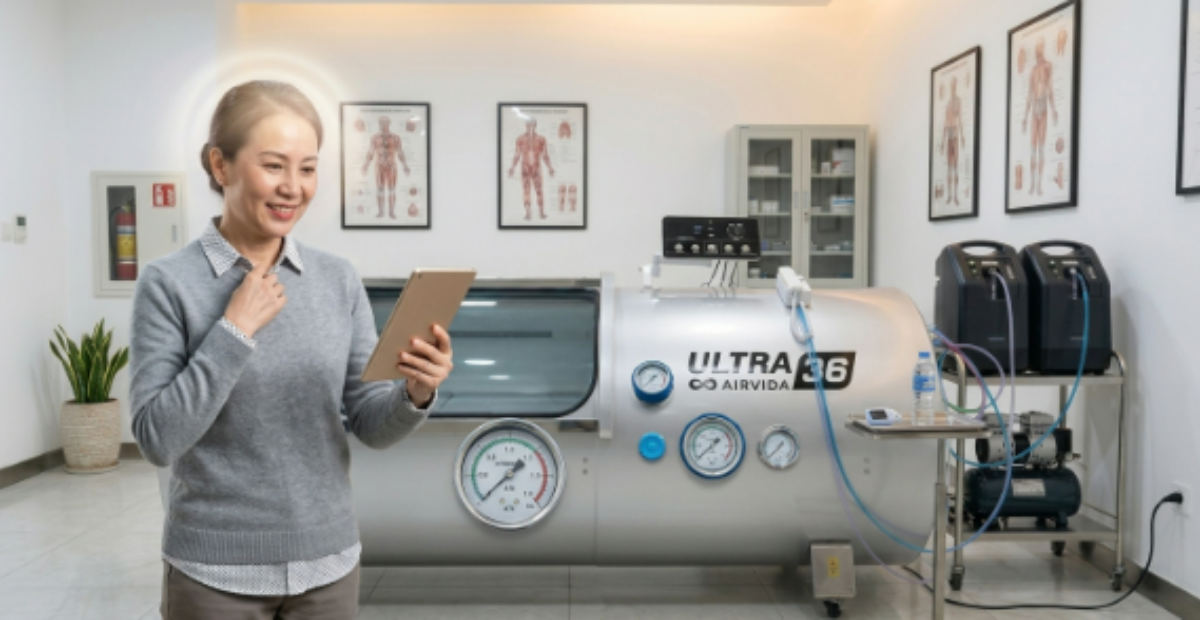
Hyperbaric chamber therapy delivers pressurized, high-concentration oxygen to the brain and body, and research suggests it can support cognitive function by increasing cerebral blood flow, reducing neuroinflammation, and promoting neuroplasticity. Studies have documented improvements in memory, attention, processing speed, and executive function following repeated hyperbaric oxygen therapy (HBOT) sessions. These effects are most consistently observed in individuals with traumatic brain injury, post-COVID cognitive symptoms, and age-related cognitive decline.
Key Takeaways
-
Hyperbaric oxygen therapy increases the amount of oxygen dissolved in blood plasma, which allows oxygen to reach tissues that compressed or damaged blood vessels cannot serve adequately.
-
Research has linked repeated HBOT sessions to measurable improvements in memory, attention, and processing speed in adults with cognitive impairment.
-
Neuroinflammation is one of the primary mechanisms targeted by HBOT, and reducing it is associated with improved cognitive clarity and reduced brain fog.
-
Neuroplasticity, the brain's ability to form new neural connections, may be enhanced by HBOT, making it a subject of active investigation in post-injury recovery protocols.
-
HBOT is not a single-session intervention: clinical protocols typically involve multiple sessions per week over several weeks for cognitive outcomes.
-
Individual results vary based on the underlying condition, number of sessions, and pressure level used, and HBOT should be integrated with a broader care plan developed with a qualified physician.
How Does a Hyperbaric Chamber Affect the Brain?
A hyperbaric chamber is a pressurized enclosure that allows you to breathe oxygen at levels higher than what is possible at normal atmospheric pressure. Under these conditions, oxygen dissolves directly into blood plasma at concentrations far exceeding standard delivery. This dramatically increases the oxygen available to brain tissue, even in regions where blood flow is compromised.
The brain is one of the most oxygen-dependent organs in the body, consuming roughly 20% of the body's total oxygen supply despite representing only about 2% of body weight. When cerebral oxygen levels drop due to injury, inflammation, or vascular dysfunction, cognitive processes are among the first to deteriorate. HBOT directly addresses this deficit by flooding tissues with bioavailable oxygen.
Beyond simple oxygen delivery, pressurized oxygen triggers downstream biological responses, including the release of growth factors, angiogenesis (the formation of new blood vessels), and modulation of inflammatory pathways. Each of these mechanisms has a direct bearing on how well your brain functions. The key point is that HBOT's cognitive benefits stem from multiple overlapping biological mechanisms, not oxygen delivery alone.
What Cognitive Functions Can HBOT Improve?

HBOT has been studied in relation to several distinct cognitive domains, including memory, attention, executive function, and information processing speed. Clinical investigations, particularly in populations with traumatic brain injury and post-COVID conditions, have reported improvements across more than one of these domains after a structured course of sessions.
Memory consolidation and recall are among the most commonly reported areas of improvement. The hippocampus, the brain region most directly involved in forming new memories, is highly sensitive to oxygen availability and inflammation. When HBOT reduces neuroinflammation and improves perfusion to this region, memory performance can improve measurably.
Attention and executive function rely on the prefrontal cortex, which is equally sensitive to metabolic disruption. Patients who report difficulty sustaining focus, organizing tasks, or filtering distractions often describe these symptoms improving over the course of an HBOT protocol. Processing speed, which reflects how quickly the brain can receive and act on information, is another domain that appears responsive to HBOT in current research. The bottom line is that HBOT's cognitive reach is broad, spanning from basic memory to complex executive processes.
Can HBOT Help With Brain Fog and Post-COVID Cognitive Symptoms?
Brain fog is a colloquial term describing a cluster of cognitive symptoms, including mental fatigue, difficulty concentrating, word-finding problems, and slowed thinking, that persists beyond an acute illness or injury. Post-COVID brain fog has become one of the most widely reported long-COVID symptoms, affecting a significant portion of individuals who experienced even mild COVID-19 infection.
The proposed mechanism connecting COVID-19 to brain fog involves persistent neuroinflammation, micro-vascular damage, and disrupted oxygen metabolism in brain tissue. HBOT directly targets all three of these pathways. By increasing plasma oxygen, reducing inflammatory cytokine activity, and promoting vascular repair, HBOT addresses the underlying biology rather than only the surface symptoms.
Clinical observations have shown that a structured course of HBOT can reduce self-reported brain fog severity and produce measurable improvements on neuropsychological assessments in post-COVID patients. This remains an area of active investigation, and individual responses vary. If you are dealing with post-COVID cognitive symptoms, discussing HBOT as part of a multimodal recovery plan with your physician is a reasonable step.
Hyperbaric Collections You May Want to Shop

What Does Research Say About HBOT and Neuroplasticity?
Neuroplasticity is the brain's capacity to reorganize itself by forming new synaptic connections, and it is the biological foundation of learning, recovery from injury, and adaptation to new experiences. HBOT is believed to support neuroplasticity through several interconnected pathways.
Elevated oxygen levels stimulate the expression of brain-derived neurotrophic factor (BDNF), a protein that supports the survival of existing neurons and encourages the growth of new ones. HBOT also promotes angiogenesis, meaning new blood vessels grow into areas of the brain that were previously under-perfused. More blood vessel coverage means more sustained oxygen delivery independent of session frequency.
Research in traumatic brain injury and stroke recovery has documented structural brain changes following repeated HBOT, including increases in gray matter volume in specific cortical regions. These findings suggest HBOT does more than temporarily boost brain oxygenation. The key point is that HBOT may actively remodel brain structure in ways that support long-term cognitive recovery, though research in this area is ongoing.
How Does HBOT Compare to Other Cognitive Support Interventions?
The table below compares HBOT to commonly used cognitive support interventions across several clinically relevant dimensions.
|
Intervention |
Primary Mechanism |
Evidence Level for Cognition |
Session Commitment |
Addresses Neuroinflammation |
|
Hyperbaric Oxygen Therapy |
Increased plasma oxygen, angiogenesis, reduced neuroinflammation |
Moderate to strong (TBI, post-COVID) |
Multiple sessions per week, 4-8 weeks |
Yes, directly |
|
Cognitive Training / Brain Games |
Synaptic reinforcement via practice |
Moderate (task-specific gains) |
Daily practice recommended |
No |
|
Exercise (Aerobic) |
Increased cerebral blood flow, BDNF release |
Strong (general population) |
3-5 sessions per week |
Indirectly |
|
Omega-3 Supplementation |
Membrane integrity, anti-inflammatory |
Moderate (mild decline) |
Daily, ongoing |
Indirectly |
|
Sleep Optimization |
Glymphatic clearance, memory consolidation |
Strong (general population) |
Nightly, ongoing |
Indirectly |
HBOT's distinguishing feature in this comparison is its ability to directly target neuroinflammation and promote angiogenesis, mechanisms that lifestyle interventions cannot replicate precisely. That said, HBOT works best when combined with sleep, exercise, and nutritional support rather than as a standalone strategy.
How Many HBOT Sessions Are Needed for Cognitive Benefits?
Protocol design, including session length, pressure level, frequency, and total number of sessions, is one of the most important variables determining cognitive outcomes in HBOT. There is no universal standard that applies to every condition, which is why physician oversight is essential.
Most clinical protocols studied for cognitive outcomes have ranged from 40 to 60 sessions, delivered 5 days per week, with each session lasting approximately 60 to 90 minutes. Shorter protocols of 20 to 30 sessions have also shown measurable effects in some populations, particularly post-COVID patients. Starting with a physician evaluation allows the protocol to be tailored to your specific condition, baseline cognitive status, and goals.
Here is a general framework used in research-based HBOT protocols for cognitive support:
-
Initial physician assessment: Establish baseline cognitive function, relevant medical history, and treatment goals.
-
Protocol selection: Determine session length (typically 60-90 minutes), pressure level, and frequency (usually 5 days per week).
-
Induction phase: First 5-10 sessions are used to assess tolerance and adjust as needed.
-
Active treatment phase: Sessions 10-40+ target the primary cognitive objectives with consistent frequency.
-
Reassessment: Neuropsychological or self-reported cognitive measures are repeated to evaluate progress.
-
Maintenance consideration: Some patients continue periodic sessions to sustain gains; this is individualized.
The bottom line is that cognitive benefits from HBOT are dose-dependent, and a structured multi-week protocol supervised by a physician produces more reliable outcomes than sporadic single sessions.
Is HBOT Used for Dementia and Age-Related Cognitive Decline?

Age-related cognitive decline and neurodegenerative conditions such as Alzheimer's disease involve progressive deterioration in cerebral blood flow, increased neuroinflammation, and accumulation of metabolic waste products in brain tissue. HBOT's mechanisms are theoretically relevant to each of these processes, which has driven growing research interest in this application. For a detailed look at how this is being explored, see this overview of hyperbaric therapy for dementia.
Preliminary research and clinical case series have reported improvements in memory and executive function in older adults with mild to moderate cognitive impairment following HBOT protocols. These findings are promising but remain preliminary; large-scale randomized controlled trials are still underway. What the current evidence does support is that HBOT is well-tolerated by older adults and does not appear to accelerate cognitive decline.
The use of HBOT in dementia care is best understood as a supportive intervention that may slow progression or improve functional capacity in some individuals, rather than a cure. Anyone considering HBOT for dementia or significant age-related decline should do so under the guidance of a neurologist or specialist familiar with both the condition and the therapy. The key point is that HBOT's role in neurodegenerative disease is a legitimate and active area of investigation, but expectations should remain calibrated to the current evidence base.
Hyperbaric Chambers You May Want to Shop
Explore More


Where Can You Access Hyperbaric Oxygen Therapy?
Accessing HBOT requires a qualified facility with appropriate medical oversight, proper chamber equipment, and individualized protocol design. Geographic access has expanded significantly as HBOT has moved into wellness-oriented clinical settings alongside traditional hospital-based programs.
If you are in the northeastern United States, you can explore hyperbaric chamber Stamford CT options for a facility near that area. On the Gulf Coast, hyperbaric chamber Sarasota FL services are available for Florida residents. For those in South Florida, hyperbaric chamber West Palm Beach FL locations offer accessible care. In Central Texas, hyperbaric chamber Round Rock TX facilities serve the greater Austin area.
When evaluating any HBOT provider, you should ask about the qualifications of the supervising physician, the type of chamber used, the protocol recommended for your condition, and how progress will be measured. These questions help ensure the therapy is delivered safely and with clinical intent.
What Is the Bottom Line on Hyperbaric Chamber Cognitive Benefits?

Hyperbaric oxygen therapy offers a biologically grounded, research-supported approach to supporting cognitive function by addressing oxygen delivery, neuroinflammation, and neuroplasticity simultaneously. The evidence is strongest for populations with traumatic brain injury, post-COVID cognitive symptoms, and age-related cognitive decline, though research across other conditions continues to build.
HBOT is not a shortcut or a replacement for comprehensive brain health practices including sleep, exercise, and nutritional support. It functions most effectively as part of an integrated, physician-supervised plan tailored to your cognitive profile and health history.
The bottom line: hyperbaric chamber therapy can support meaningful cognitive improvements in the right clinical context, with the most consistent results seen in structured multi-week protocols delivered under medical supervision.
Frequently Asked Questions
Is a hyperbaric chamber good for the brain?
Yes, a hyperbaric chamber can benefit the brain by increasing oxygen availability to cerebral tissue, reducing neuroinflammation, and promoting the growth of new blood vessels. These mechanisms support memory, attention, and processing speed. The strongest evidence exists for traumatic brain injury and post-COVID cognitive symptoms, and research in other conditions continues to expand.
How many times a week should you do HBOT?
Most research-based HBOT protocols for cognitive benefits involve five sessions per week, typically for four to eight weeks. Some protocols use three sessions per week with a longer overall duration. The right frequency for you depends on your specific condition and goals, which is why a physician assessment before starting is essential.
Can HBOT help with brain fog?
Yes, HBOT can help with brain fog by targeting the neuroinflammation and micro-vascular disruption that drive it, particularly in post-COVID cases. Patients commonly report improved mental clarity, faster thinking, and better word retrieval following a structured course of sessions. Results vary, and HBOT should be part of a broader recovery plan.
What is the miracle of hyperbaric oxygen therapy?
The most remarkable aspect of HBOT is its ability to increase oxygen delivery to damaged or under-perfused tissue without surgery or medication, while simultaneously triggering angiogenesis, BDNF release, and inflammation reduction. This combination of effects allows the brain to repair and reorganize in ways that are difficult to achieve through other single interventions. It is biology, not magic, but the outcomes in some patients are clinically striking.
Does HBOT make you look younger?
HBOT has been studied for its effects on cellular aging, particularly its influence on telomere length and senescent cell activity, with some research suggesting it may support markers associated with slower biological aging. Improved skin oxygenation and collagen synthesis have also been proposed as contributors to skin appearance changes some patients report. These findings are preliminary, and anti-aging claims should be interpreted cautiously pending further research.