


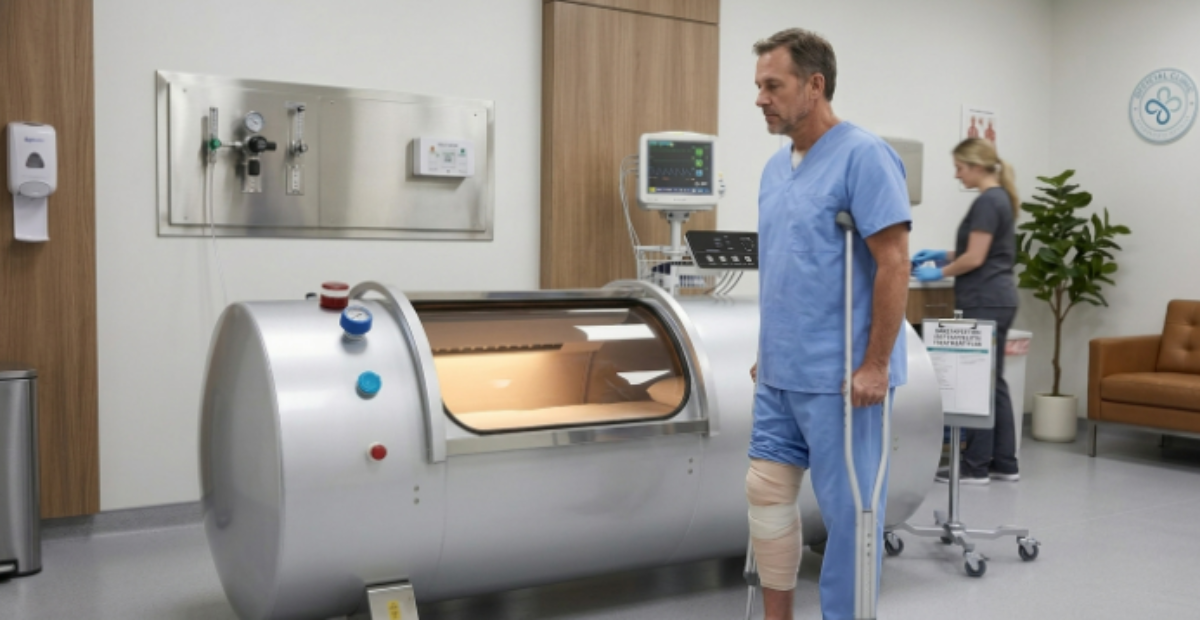
A hyperbaric chamber delivers 100% oxygen at pressures greater than one atmosphere, raising oxygen levels in infected bone tissue where circulation is compromised. For bone infections, specifically osteomyelitis, hyperbaric oxygen therapy (HBOT) is used as an adjunct to surgery and antibiotics, not as a standalone cure. Clinical literature supports its use for chronic, refractory cases where standard treatment has failed, with one large cohort study reporting a recurrence rate of only 15% at two-year follow-up when HBOT was added to surgical and antibiotic care.
Key Takeaways
-
Hyperbaric oxygen therapy is an adjunctive treatment for osteomyelitis, meaning it works alongside antibiotics and surgical debridement, not instead of them.
-
HBOT raises oxygen tension in hypoxic bone tissue, restoring the conditions needed for immune cells to kill bacteria effectively.
-
A typical course involves 20 to 40 sessions delivered once daily at 2.0 to 3.0 atmospheres absolute (ATA) for 90 to 120 minutes per session.
-
Chronic refractory osteomyelitis is the primary indication, covering cases that have not responded to prior standard medical and surgical management.
-
A 2025 NIH StatPearls review confirms that HBOT enhances tissue oxygenation and supports antimicrobial activity in patients unresponsive to conventional treatment.
-
Certain medical conditions are absolute contraindications to hyperbaric therapy, so patient screening is required before starting a course.
What Is Osteomyelitis and Why Is It So Difficult to Treat?
Osteomyelitis is a bacterial or, less commonly, fungal infection of bone tissue that creates a low-oxygen, high-acidity environment where standard treatments frequently fail. Bacteria colonize the bone, trigger inflammation, and disrupt the local blood supply, which in turn reduces the delivery of antibiotics and immune cells to the site of infection. This self-reinforcing cycle is why osteomyelitis often becomes chronic and recurrent.
The infection can arise from direct trauma, surgery, a nearby soft-tissue infection, or through the bloodstream from a distant source. Diabetic foot infections, hardware-related infections after orthopedic procedures, and post-traumatic bone infections are among the most common presentations in clinical practice. Each of these settings shares the common feature of impaired local vascularity, which is precisely what HBOT is designed to address.
Refractory osteomyelitis refers to cases that persist or recur despite appropriate antibiotic therapy and surgical debridement. According to a 2025 NIH StatPearls review, this is the population most likely to benefit from adjunctive HBOT.
The key point is: osteomyelitis becomes refractory largely because the infected bone is hypoxic, and restoring oxygen to that tissue is both the rationale and the target of hyperbaric therapy.
How Does a Hyperbaric Chamber Work for Bone Infections?

HBOT for bone infections works by dissolving oxygen directly into plasma and tissue fluid, bypassing the hemoglobin-bound oxygen delivery that fails in poorly vascularized bone. Breathing pure oxygen at elevated pressure increases tissue oxygen tension well beyond what is achievable at sea level, temporarily reversing the hypoxic conditions that protect bacteria from immune attack.
The mechanism is not simply flooding the area with oxygen. Research cited in StatPearls shows that the primary action is indirect: HBOT improves local vascularity and potentiates phagocytosis, which is the process by which white blood cells engulf and destroy bacteria. Neutrophils require oxygen to generate the reactive species that kill gram-negative and gram-positive pathogens, and they are significantly impaired in hypoxic tissue.
There is also a direct antibacterial effect. Experimental data show that HBOT has bactericidal activity equivalent to antibiotics against strictly anaerobic organisms. A 2025 PMC review on bone-related diseases additionally notes that when delivered within safe limits, HBOT promotes bone healing and repair by stimulating angiogenesis and supporting osteoblast activity.
The bottom line is: HBOT corrects the oxygen deficit in infected bone, simultaneously supporting the immune response, enhancing antibiotic effectiveness, and promoting new bone and blood vessel formation.
What Does the Clinical Evidence Show for Osteomyelitis?
The clinical evidence for HBOT in osteomyelitis is consistent across multiple published cohort studies, though randomized controlled trials remain absent, a limitation the medical community acknowledges. The Undersea and Hyperbaric Medical Society (UHMS) classifies chronic refractory osteomyelitis as an approved indication for HBOT, and the American Heart Association has issued a Class II recommendation for its use in this setting.
Key findings from peer-reviewed literature include:
-
A PubMed cohort study of 40 patients with chronic osteomyelitis treated with HBOT as an adjunct to surgery and antibiotics reported a recurrence rate of 15% at an average two-year follow-up.
-
A published PubMed study on spinal osteomyelitis reported infection cure in 5 of 6 patients who had failed primary therapy or had significant medical comorbidities.
-
A 2003 retrospective PubMed study confirmed that HBOT is both effective and safe for chronic refractory osteomyelitis when patients have received appropriate medical and surgical management first.
-
A 2024 to 2025 ScienceDirect case series of 11 patients with chronic post-traumatic osteomyelitis, including six refractory cases, demonstrated favorable outcomes with combined surgical debridement, antibiotics, and adjunctive HBOT.
A 2025 PMC review on craniomaxillofacial diseases also highlights HBOT's capacity to promote angiogenesis, reduce inflammation, enhance bone regeneration, and exert antibacterial effects, supporting its broad utility across different anatomical sites of bone infection.
The key point is: while randomized trial data are lacking, consistent findings across multiple study designs and anatomical sites support HBOT as a meaningful adjunct for refractory osteomyelitis.
Hyperbaric Collections You May Want to Shop

What Are the Standard Treatment Protocols and Session Requirements?
The standard HBOT protocol for osteomyelitis involves daily sessions at pressurized oxygen levels calibrated to penetrate hypoxic bone tissue while remaining within physiologically safe limits. Treatment is typically initiated after or alongside surgical debridement and culture-directed antibiotic therapy.
Standard HBOT Protocol for Osteomyelitis
|
Parameter |
Standard Range |
|
Pressure |
2.0 to 3.0 atmospheres absolute (ATA) |
|
Session duration |
90 to 120 minutes |
|
Frequency |
Once daily, five to seven days per week |
|
Total sessions |
20 to 40 sessions |
|
Timing relative to surgery |
Initiated soon after clinically indicated debridement |
|
Antibiotic integration |
Concurrent with culture-directed antibiotics |
According to a PubMed review on refractory osteomyelitis, the best clinical results are obtained when HBOT is administered in conjunction with culture-directed antibiotics and initiated promptly after surgical debridement. Delaying HBOT until infections become more advanced reduces its effectiveness. The same source confirms that 20 to 40 sessions are typically required to achieve sustained therapeutic benefit.
The bottom line is: HBOT for bone infection is a multi-week commitment that must be integrated into a coordinated care plan including surgery and targeted antibiotics.
Which Types of Bone Infections Benefit Most From HBOT?
Chronic refractory osteomyelitis is the primary indication for HBOT, defined as an infection that persists or recurs despite repeated courses of antibiotics and appropriate surgical management. Several sub-categories of osteomyelitis have been studied, with varying levels of evidence.
Types of bone infection where HBOT has shown benefit include:
-
Chronic refractory osteomyelitis: The best-documented indication, supported by the UHMS approval and multiple cohort studies.
-
Post-traumatic osteomyelitis: A 2025 ScienceDirect case series demonstrated favorable outcomes in patients with trauma-related bone infections, including refractory cases.
-
Spinal osteomyelitis with comorbidities: A published spinal osteomyelitis study identified HBOT as particularly beneficial when medical comorbidities increase the risk of poor healing.
-
Jaw and craniomaxillofacial osteomyelitis: A Springer chapter on osteomyelitis of the jaws supports HBOT as an adjunct in mandibular and craniofacial cases.
-
Osteomyelitis in compromised hosts: A PMC study on compromised hosts confirms that patients with conditions reducing immune function or circulation, such as diabetes or peripheral vascular disease, represent a group where HBOT provides meaningful support.
Acute osteomyelitis in otherwise healthy patients without vascular compromise may respond well to antibiotics alone, making HBOT less necessary in that population. The key point is: the greater the degree of tissue hypoxia, vascular impairment, or treatment failure, the stronger the rationale for adding HBOT.
How Does HBOT Complement Antibiotics and Surgery?

HBOT complements antibiotics and surgery by restoring the oxygen conditions needed for both treatments to work effectively in infected bone. Antibiotics depend on oxygen-dependent transport mechanisms and are less effective in hypoxic tissue. Surgical debridement removes necrotic bone but cannot independently restore the vascular supply needed for healing.
HBOT addresses the gaps left by both:
-
It raises local tissue oxygen tension, reversing the hypoxic environment that shields bacteria and impairs neutrophil function.
-
It enhances antibiotic efficacy, particularly for aminoglycosides, which require oxygen-dependent bacterial uptake mechanisms.
-
It stimulates angiogenesis, promoting the growth of new blood vessels into the debrided bone site, which is essential for long-term healing.
-
It supports osteoblast activity, which is necessary for new bone formation after infection control is achieved.
The 2025 PMC review notes that HBOT, when administered within safe limits, can promote bone healing and repair, a function that goes beyond infection control and into actual structural recovery. HBOT does not replace debridement or antibiotics. Rather, the combination of all three produces outcomes superior to any single modality alone.
The bottom line is: HBOT, antibiotics, and surgery form a three-part strategy where each element addresses a different limitation of the others.
What Are the Contraindications and Safety Considerations for Hyperbaric Therapy?
Certain conditions make hyperbaric oxygen therapy unsafe, and every patient must be screened before starting a course of treatment. Contraindications exist because pressurized oxygen affects lung physiology, gas-filled cavities in the body, and cardiovascular function.
Absolute and relative contraindications include:
-
Untreated pneumothorax: A collapsed lung cannot be safely pressurized and represents an absolute contraindication.
-
Certain chemotherapy agents: Some agents interact adversely with high-pressure oxygen.
-
Severe emphysema with CO2 retention: Altered respiratory drive in these patients creates risk under pressure.
-
Active middle ear or sinus conditions: Inability to equalize pressure can cause barotrauma.
-
Uncontrolled seizure disorders: Oxygen toxicity at high pressure can lower the seizure threshold.
-
Claustrophobia: Patients unable to tolerate enclosed spaces may require management strategies or may not be suitable candidates.
-
Pregnancy: Remains an area of ongoing investigation regarding safety parameters.
A 2003 PubMed retrospective study confirmed that HBOT is safe for refractory osteomyelitis provided patients have received appropriate medical and surgical management, which includes the pre-treatment screening process. Side effects in monitored clinical settings are generally mild and may include ear pressure discomfort and temporary visual changes.
The key point is: HBOT has a well-established safety profile in supervised clinical settings, but proper patient screening for contraindications is non-negotiable before beginning treatment.
Hyperbaric Chambers You May Want to Shop
Explore More


What Is the Outlook for Patients Using HBOT for Bone Infection?
The outlook for patients with chronic refractory osteomyelitis who receive adjunctive HBOT is meaningfully better than for those receiving surgery and antibiotics alone, based on available cohort data. A two-year recurrence rate of 15% in a cohort of 40 patients treated with HBOT, surgery, and antibiotics represents a strong outcome for a condition known for high recurrence when treated conventionally.
Factors that improve the outlook include:
-
Starting HBOT promptly after surgical debridement
-
Using culture-directed antibiotics rather than empirical therapy
-
Completing the full prescribed course of 20 to 40 sessions
-
Addressing underlying comorbidities such as diabetes, peripheral vascular disease, and malnutrition
-
Selecting patients whose infections are confirmed to be refractory or complicated by poor vascularity
Ongoing research continues to expand the evidence base. A clinical trial investigating adjunctive HBOT for necrotizing soft-tissue infections (HOT-NSTI Trial, ClinicalTrials.gov NCT07489274) began recruiting in April 2026 with primary completion expected in 2033, which will add to the broader understanding of HBOT in serious soft-tissue and bone-adjacent infections.
The bottom line is: patients with refractory or complicated osteomyelitis who are appropriate candidates for HBOT, and who complete a full course integrated with surgery and antibiotics, can expect meaningfully improved infection control and reduced recurrence compared to conventional treatment alone.
Is a Hyperbaric Chamber the Right Choice for Your Bone Infection?

The decision to use a hyperbaric chamber for a bone infection depends on the type of osteomyelitis, the patient's treatment history, and their overall medical status. HBOT is not a first-line treatment for acute, uncomplicated bone infections. It is most appropriate when infection is chronic, refractory, or occurs in patients with conditions that impair tissue oxygenation and healing.
If you have been diagnosed with osteomyelitis that has not responded to standard antibiotic and surgical treatment, a consultation with a physician trained in hyperbaric medicine is the appropriate next step. That physician will review your imaging, culture results, surgical history, and comorbidities to determine whether you meet the criteria for adjunctive HBOT.
The bottom line: hyperbaric oxygen therapy is a clinically supported adjunct for chronic refractory osteomyelitis that, when combined with surgery and culture-directed antibiotics, improves infection resolution rates and reduces recurrence in appropriately selected patients.
Frequently Asked Questions
Does hyperbaric chamber help with bone healing?
Yes, hyperbaric oxygen therapy helps bone healing by raising oxygen tension in hypoxic tissue, stimulating angiogenesis, and supporting osteoblast activity. A 2025 PMC review confirmed that HBOT, when delivered within safe limits, promotes bone healing and repair beyond its antibacterial effects. These mechanisms make it valuable not only for infection control but also for restoring bone structure after debridement.
Can hyperbaric therapy be used to treat infections?
Yes, hyperbaric therapy can be used to treat certain infections as an adjunct to antibiotics and surgery. It is most established for chronic refractory osteomyelitis and has demonstrated bactericidal activity against anaerobic organisms. It works by correcting the hypoxic tissue environment that protects bacteria from immune and antibiotic attack, rather than serving as a standalone antimicrobial agent.
What is the most effective treatment for osteomyelitis?
The most effective treatment for osteomyelitis is a combination of surgical debridement, culture-directed antibiotic therapy, and adjunctive HBOT for refractory or complicated cases. No single modality is sufficient on its own for chronic or refractory disease. Clinical evidence consistently shows superior outcomes when all three components are used together in appropriately selected patients.
How quickly can osteomyelitis destroy bone?
Osteomyelitis can begin causing structural bone damage within days to weeks of infection onset, with acute hematogenous osteomyelitis progressing particularly rapidly in children. Chronic infection leads to the formation of avascular necrotic bone, called sequestrum, which can persist for months without proper treatment. The speed of destruction depends on the pathogen, the patient's immune status, and how quickly treatment is initiated.
When should you not use a hyperbaric chamber?
You should not use a hyperbaric chamber if you have an untreated pneumothorax, certain pulmonary conditions with CO2 retention, active middle ear or sinus disease preventing pressure equalization, or contraindicated concurrent medications. Patients with uncontrolled seizure disorders also require careful evaluation before proceeding. A thorough medical screening by a hyperbaric medicine physician is required to determine individual suitability before any course of treatment begins.